Keywords
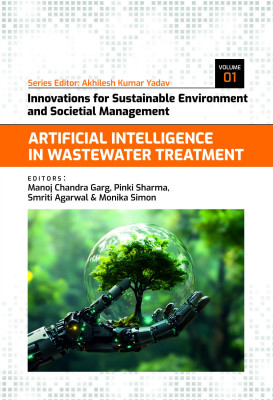
Artificial Intelligence in Wastewater, Machine Learning ,Smart Water Treatment, Real-Time Monitoring,Process Automation,Predictive Analytics, Wastewater Modelling,, Neural Networks, Fuzzy Logic Systems, Internet of Things (IoT), SCADA Integration, Decision Support Systems,Optimization Algorithms, Energy-Efficient Treatment, Sludge Valorization, Circular Economy, Smart Sensors, Water Reuse Optimization, Explainable AI, Sustainable Wastewater ManagementArtificial Intelligence in Wastewater Treatment: Volume 01 : Innovations For Sustainable Environment and Societial Management - Volume 01
edited by: Manoj Chandra Garg, Pinki Sharma, Smriti Agarwal & Monika SimonLength: 152 mm | Breadth: 17 mm | Height: 229 mm | Imprint: NIPA | Weight: 675 GMS
This book provides a forward-looking and practical examination of how Artificial Intelligence (AI) is reshaping wastewater treatment and advancing sustainable environmental management. Organized into four thematic parts, it bridges foundational knowledge with cutting-edge innovations, offering an integrated view of the future of water technologies.
The book begins with the fundamentals of AI and machine learning as applied to core wastewater processes. Readers learn how intelligent algorithms—ranging from neural networks to optimization models—enable accurate forecasting, dynamic control, and enhanced biological treatment efficiency. The second part highlights AI-driven monitoring and automation, including smart sensors, SCADA-enabled systems, and real-time process adjustments that improve operational stability and regulatory compliance.
Decision-support tools and emerging technologies form the focus of Part III. This section explores multi-criteria evaluation frameworks, IoT-connected smart plants, predictive analytics, and next-generation advancements such as explainable AI. The final part addresses sustainability and specialized applications, detailing AI-driven strategies for sludge valorization, zero-waste initiatives, high-salinity wastewater treatment, and optimized water reuse.
Combining scientific depth with practical insights, this book serves as an essential resource for researchers, engineers, utility managers, environmental consultants, and policymakers committed to building smarter, more resilient, and sustainable wastewater management systems.
Dr. Manoj Chandra Garg is an Assistant Professor at the Amity Institute of Environmental Sciences, Amity University Uttar Pradesh, with over a decade of teaching and research experience. He earned his Ph.D. from the Indian Institute of Technology (IIT) Roorkee, focusing on solar photovoltaic assisted nanofiltration and reverse osmosis membrane water treatment systems. He also holds an M.Tech. in Environmental Science & Technology from Thapar University, where he was awarded a Gold Medal. Dr. Garg’s research spans water quality, membrane filtration technologies, solar desalination, biosorption, and the application of machine learning and artificial intelligence in environmental systems. He has published extensively with several journal articles and holds various patents. His research has been supported by significant projects, including a grant from the Science and Engineering Research Board (SERB) under the Early Career Research Award. Dr. Garg is actively involved in academic committees and collaborations with international institutions.
Dr. Pinki Sharma completed her M.Tech. in Environmental Engineering from Thapar University and earned her Ph.D. in industrial wastewater treatment using advanced technologies from IIT Roorkee. She has research experience as a Research Associate on the UK-FAR GANGA project at NIH Roorkee and was awarded the DST Women Scientist A Fellowship. Her research interests focus on water and wastewater treatment, membrane technology, electrochemical treatment, capacitive deionization, and other advanced treatment techniques.
Dr. Smriti Agarwal is an Assistant Professor in the Department of Electronics and Communication Engineering at Motilal Nehru National Institute of Technology (MNNIT), Allahabad. She completed her Ph.D. from IIT Roorkee in the area of millimeter wave imaging radar for target detection. Dr. Agarwal’s research interests include microwave and millimeter wave imaging, metamaterials, antenna design, AI and machine learning applications in communication and imaging. She has several published journal articles and has received multiple fellowships and awards including the DST Women Scientist fellowship. She has extensive experience in research and academic leadership roles.
Dr. Monika Simon holds a Ph.D. in Environmental Engineering and Sciences from IIT Roorkee and is currently a Postdoctoral Researcher at SRM University-AP, Andhra Pradesh. She has industrial experience in wastewater treatment and has worked on international collaborative research projects. Dr. Simon’s research focuses on microbial bioremediation, biodegradation of microplastics, and developing sustainable water treatment technologies. She has authored several peer-reviewed articles and holds a patent related to wastewater treatment innovations.
Part I: AI and Machine Learning in Core Wastewater Treatment Processes
Chapter 1: Machine Learning Applications in Wastewater Treatment
Chapter 2: Optimization of Biological Treatment Processes Using AI
Chapter 3: AI for Energy Efficiency in Wastewater Treatment
Chapter 4: AI-Powered Wastewater Treatment System Design and Optimization
Part II: AI-Enabled Monitoring, Control, and Automation
Chapter 5: Artificial Intelligence for Wastewater Quality Monitoring, Process Control, and Automation
Chapter 6: Smart Wastewater Systems: Leveraging AI for Quality Monitoring and Assessment
Chapter 7: AI-Driven Process Control and Automation”
Part III: Decision Support, Evaluation, and Emerging Technologies
Chapter 8: AI-Based Decision Support Systems for Wastewater Management
Chapter 9: Future Perspectives and Emerging Trends in AI for Wastewater Treatment
Chapter 10: AI-Enabled Fuzzy Multi-Criteria Approach for Evaluating Wastewater Treatment Technologies
Chapter 11: AI and Internet of Things (IoT) Integration in Smart Wastewater Systems
Part IV: Sustainability and Specialized Applications
Chapter 12: AI for Sludge Management and Byproduct Utilization
Chapter 13: Harnessing Artificial Intelligence for Sustainable Management of Saline Wastewater in Rajasthan's Saline Lakes
Chapter 14: Wastewater Reuse Optimization Using Machine Learning