Keywords
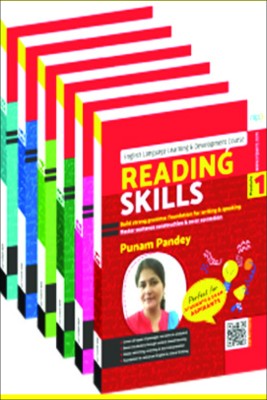
Reading Strategies, Skimming, Scanning, Contextual Vocabulary, Linking Words, Paragraph Coherence, Descriptive Writing, Informal Letters, Email Etiquette, Pronunciation, Tone & Pitch, Active Listening, Paralanguage, Tenses, Modals, Subject-Verb Agreement,Phrasal Verbs, Prefix–Suffix, Synonyms–Antonyms, IdiomsEnglish Language Learning and Development Course: (Set of 6 Vols.) (PB): Volume 10 : Skill and Entrepreneurship Development - Volume 10
authored by: Punam PandeyLength: mm | Breadth: mm | Height: mm | Imprint: NIPA | Weight: GMS
This course is created to help students to develop strong English language skills for academics, communication, and daily life. The book is divided into six easy-to-follow modules:
1. Reading Skills: Learn how to read with better understanding, find the main idea, connect sentences and paragraphs, and answer questions from passages.
2. Writing Skills: Improve your writing by learning how to write about yourself, describe events, write letters, emails, and short essays in a clear and correct way.
3. Speaking Skills: Build confidence to speak in English during everyday conversations, classroom discussions, interviews, and formal events. Focus is on pronunciation, tone, and speaking naturally.
4. Listening Skills: Become a better listener during lectures, interviews, and presentations. Learn to focus, understand clearly, and respond correctly.
5. Grammar Skills: Understand and use correct grammar in sentences. Topics include tenses, verbs, adjectives, modals, punctuation, and sentence structure.
6. Vocabulary Skills: Learn new words for travel, shopping, weather, and more. Practice phrasal verbs, idioms, synonyms, antonyms, and word-building.
This book uses simple language, practical examples, and student-friendly exercises. It will help you speak, read, write, and understand English better—both in your studies and in everyday life. It's a complete guide to becoming confident in English.
01. READING MODULE
1.1. Steps to Effective Reading
1.1.1. Explanation:
1.1.2. Importance of slow reading
1.1.3. Underlining main points
1.1.4. Contextualise it (what the write up is about)
1.2. Identifying types of sources like newspapers, magazines, journals, etc. Types of reading comprehension
1.2.1. Narrative
1.2.2. Descriptive
1.2.3. Factual/Expository/Informative
1.2.4. Argumentative/Persuasive
1.2.5. Analytical
1.3. Understanding the passage
1.3.1. Difference between words, phrases, sentences
1.3.2. Finding linkages between sentences and paragraphs
1.3.3. Introducing linking words
1.3.4. Make them identify how every paragraph has a particular theme and a connection with the passage as a whole.
1.4. Finding Words
1.4.1. Try to increase your vocabulary
1.4.2. Try to evaluate the sentence whose some words are not understandable based on its meaning, word usage, meaning it intends to offer
1.4.3. If you are confused between two meanings of the same word, try to substitute the word with its synonyms. In most cases, you can choose the correct option between the two
1.5. Formulating opinions
1.5.1. Skimming, scanning, main idea, supporting ideas, understanding infographics, listening strategies
1.5.2. How to respond to questions following a reading passage?
1.5.3. Understanding of tone, setting and context
1.5.4. Evaluating the question
1.5.5. Objective vs subjective answer writing
2. WRITING MODULE
2.1. Descriptive writing: Self Introduction
2.2. Describing Past Events
2.3. Descriptive writing: Favourite food, holiday destination
2.4. Informal letters: Thanking a friend
2.5. Messages for Various Purposes
2.6. Writing a letter of Application
2.7. Writing Emails
2.8. Informative writing- Factual essays
3. SPEAKING MODULE
3.1. Everyday conversations, e.g. workplace interactions, travelling, communicating with friends, etc.
3.2. Accuracy, Tone and Pitch
3.3. Pronunciation Matters: Commonly mispronounced words
3.4. Learning to introduce oneself effectively in formal and informal events.
3.5. Conveying Opinions and Making Plans
3.6. Initiating Discussions
4. LISTENING MODULE
Listening Skills - For Lectures, Presentations, Examinations and Interviews, etc.
4.1. How to become an effective listener?
4.2. What is communication?
4.3. Active and Passive Listening
4.4. Listening to complex words followed by medium-length sentences.
4.5. Importance of Paralanguage (Learning techniques to show involvement, interest in conversation vs boredom, disinterestedness)
5. GRAMMAR MODULE
5.1. Adjectives: Types, Degree, Order
5.2. Questions Words and Question Tags
5.3. Present Simple /Continuous
5.4. Past Simple and Past Continuous
5.5. Predictions and future events
5.6. Subject-Verb Agreement
5.7. Regular and Irregular Verbs
5.8. Adverbs of Frequency and Manner
5.9. Modals
5.10. Pronouns
5.11. Prepositions
5.12. Conjunctions
5.13. Determiners
5.14. Active-Passive
5.15. Rules of Punctuation
6. VOCABULARY MODULE
6.1. Vocabulary for Regular Use -Travel, Shopping, Weather, etc.
6.2. Phrasal verbs and Collocations in daily conversations
6.3. Identify Root Words, Suffixes and Prefixes
6.4. Synonyms and Antonyms
6.5. Portmanteau words and Transitional words
6.6. Idioms