Keywords
Ecosystem structure & energy flow (10% rule), Food chain/web & ecological pyramids, Biogeochemical cycles (C/N/P), Biodiversity hotspots & biogeographical zones (India),Endemic, keystone & invasive species, Eutrophication; bioaccumulation/biomagnification,BOD/COD (water quality), AQI, PM₂.₅/PM₁₀ (air), Noise levels (dB) & health effects, Solid Waste Management (3Rs, composting, landfill, pyrolysis), Biogas—anaerobic digestion, Rainwater harvesting & watershed management, Climate change vs global warming; GHGs, Ozone layer depletion & UV-B Environmental ethics & sustainable development, Environment Protection, Air, Water, Wildlife, Forest Acts, Disaster risk = hazard × vulnerability ÷ capacity, Disaster management cycle (mitigation–preparedness–response–recovery), Early warning systems & Incident Command System (ICS) Community-based disaster management; roles of NDMA/NDRF/NGOs & media, ICAR 6th Deans SyllabusEnvironmental Studies and Disaster Management
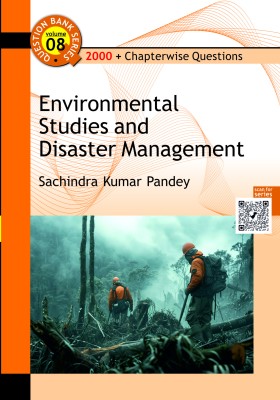
authored by: Sachindra Kumar PandeyLength: 152 mm | Breadth: 15.3 mm | Height: 229 mm | Imprint: CONTENT VIBES | Weight: 700 GMS
The book is in accordance with the recommendations of the ICAR Sixth Deans' Committee and NEP-2020, Fundamentals of Environmental Science provides a comprehensive, interdisciplinary, and outcome-based understanding of environmental systems and their significance in sustainable development. The book is designed to equip undergraduate students with the knowledge, skills, and environmental awareness required to address contemporary ecological challenges and promote responsible stewardship of natural resources.
The text systematically covers the concepts of environment and ecosystems, natural resources, biodiversity and its conservation, environmental pollution, waste management, environmental ethics, climate change, environmental legislation, and disaster management. The subject matter is presented in a simple, student-friendly manner through illustrations, flowcharts, diagrams, and practical examples that promote conceptual understanding, analytical thinking, and problem-solving skills.
Special emphasis has been placed on contemporary environmental issues such as sustainable resource utilization, renewable energy, climate resilience, community participation, and environmental governance. Real-life case studies and practical applications have been incorporated to bridge theoretical concepts with field situations and policy perspectives.
Salient Features
• Fully aligned with the ICAR Sixth Deans' Committee syllabus and course outcomes.
• Outcome-based and competency-driven approach in accordance with NEP-2020.
• Comprehensive coverage of ecosystems, natural resources, biodiversity, pollution, climate change, environmental laws, and disaster management.
• Student-friendly presentation through illustrations, flowcharts, summary tables, and case studies.
• Emphasis on environmental ethics, sustainability, and responsible resource management.
• Includes chapter-end review questions, objective questions, and self-assessment exercises.
• Promotes critical thinking, environmental awareness, and problem-solving abilities.
• Useful for classroom teaching, practical training, experiential learning, and competitive examination preparation.
This textbook is primarily intended for undergraduate students of Agriculture and allied sciences, and will also serve as a valuable reference for postgraduate students, teachers, researchers, extension professionals, and all learners interested in environmental conservation and sustainable development.
Sachindra Kumar Pandey is currently serving as Senior Scientist and Head at the Krishi Vigyan Kendra, Indira Gandhi National Tribal University (A Central University), Amarkantak, Anuppur, Madhya Pradesh. He holds a B.Sc. in Agriculture and an M.Sc. (Ag.) in Agricultural Extension from Jawaharlal Nehru Krishi Vishwa Vidyalaya, Jabalpur. He earned his Ph.D. in Agricultural Extension from Mahatma Gandhi Chitrakoot Gramoday Vishwavidyalaya, Chitrakoot, Satna (M.P.), and also holds a Post Graduate Diploma in Agricultural Extension Management from MANAGE, Hyderabad.
With over 25 years of professional experience in agricultural extension, particularly within the Krishi Vigyan Kendra (KVK) system, Dr. Pandey has led numerous training programs, on-farm demonstrations, and extension activities catering to diverse stakeholders, including farmers, extension personnel, and rural youth.
He is a life member of several prestigious professional bodies, including the Indian Society of Extension Education (IARI, New Delhi) and the Society of Extension Education (Agra, U.P.). Dr. Pandey has made significant contributions to agricultural research and communication, with more than 26 research papers and over 30 popular articles published in reputed national journals, magazines, and newspapers.
Throughout his distinguished career, he has received multiple accolades, such as the Young Scientist Award, Best KVK Professional Award, and awards for Best Paper and Best Poster Presentation from various recognized institutions.
1 Introduction to Environment - Environmental Studies: Definition, Scope and Importance Multidisciplinary Nature of Environmental Studies - Segments of Environment
2 Spheres of Earth- Lithosphere - Hydrosphere - Atmosphere - Different Layers of Atmosphere
3 Natural Resources: Classification - Forest Resources. Water Resources. Mineral Resources Food Resources. Energy resources. Land Resources. Soil Resources
4 Ecosystems: Concept of an Ecosystem - Structure and Function of an Ecosystem - Energy Flow in The Ecosystem. Types of Ecosystem
5 Biodiversity and Its Conservation: Introduction, Definition, Types. Biogeographical Classification of India.
6 Importance and Value if Biodiversity. Biodiversity Hot Spots. Threats and Conservation of Biodiversity
7 Environmental Pollution: Definition, Cause, Effects and Control Measures of: A. Air Pollution.B. Water Pollution. C. Soil Pollution. D. Marine Pollution. E. Noise Pollution. F. Thermal Pollution H. Light Pollution
8 Solid Waste Management: Classification of Solid Wastes and Management Methods, Composting, Incineration, Pyrolysis
9 Biogas Production, Causes, Effects and Control Measures of Urban and Industrial Wastes
10 Social Issues and The Environment: Urban Problems Related to Energy
11 Water Conservation, Rain Water Harvesting, Watershed Management
12 Environmental Ethics: Issues and Possible Solutions, Climate Change, Global Warming, Acid Rain, Ozone Layer Depletion, Nuclear Accidents and Holocaust
13 Environment Protection Act. Air (Prevention and Control of Pollution) Act. Water (Prevention and Control of Pollution) Act. Wildlife Protection Act. Forest Conservation Act
14 Human Population and The Environment: Environment and Human Health: Human Rights, Value Education. Women and Child Welfare.
15 Role of Information Technology in Environment and Human Health
16 Disaster Management: Disaster Definition - Types - Natural Disasters - Floods, Drought, Cyclone, Earthquakes, Landslides, Avalanches, Volcanic Eruptions, Heat and Cold Wave
17 Man Made Disasters: Nuclear Disasters, Chemical Disasters, Biological Disasters, Building Fire, Coal Fire, Forest Fire, Oil Fire, Road Accidents, Rail Accidents, Air Accidents, Sea Accidents
18 International and National Strategy for Disaster Reduction. Concept of Disaster Management, National Disaster Management Framework; Financial Arrangements
19 Role of Ngos, Community-Based Organizations and Media in Disaster Management. Central, State, District and Local Administration in Disaster Control; Armed Forces in Disaster Response
20 Police and other Organizations in Disaster Management