Keywords
Artificial Intelligence in Manufacturing, Smart Manufacturing, Intelligent Automation, Industry 4.0, Industry 5.0, Machine Learning in Manufacturing, Industrial IoT, Cyber-Physical Systems, Digital Twins, Predictive Maintenance, Computer Vision, Robotics and Automation, Edge AI, Cloud Manufacturing, Additive Manufacturing, Big Data Analytics, Supply Chain Optimization, Sustainable Manufacturing, Autonomous Factories, Real-Time Industrial AnalyticsAI-Enabled Manufacturing Processes and Intelligent Automation : Volume 02 : Integration of AI and ML into Manufacturing - Volume 02
edited by: Hitesh VasudevLength: 152 mm | Breadth: 18.5 mm | Height: 229 mm | Imprint: NIPA | Weight: 700 GMS
This book will be available from 13-Sep-2026
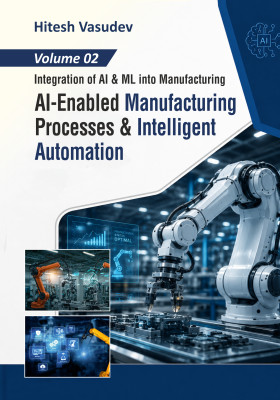
AI-Enabled Manufacturing Processes and Intelligent Automation provides a comprehensive exploration of the transformative role of artificial intelligence in modern manufacturing systems. The book presents the foundational concepts of AI, machine learning, deep learning, reinforcement learning, and computer vision, highlighting their applications in intelligent production, adaptive control, quality inspection, and automated decision-making. It examines the integration of cyber-physical systems, Industrial Internet of Things (IIoT), digital twins, cloud manufacturing, and edge AI technologies that are shaping smart and connected manufacturing environments.
Special emphasis is given to intelligent automation, predictive maintenance, supply chain optimization, additive manufacturing, materials processing, and sustainable manufacturing practices driven by real-time analytics and data-centric approaches. The volume also addresses important concerns related to data security, ethical implications, workforce transformation, and human–machine collaboration in AI-driven industries.
Designed for researchers, academicians, engineers, and industry professionals, this book serves as a valuable resource for understanding emerging trends such as Industry 5.0, autonomous factories, and future intelligent manufacturing ecosystems.
Dr. Hitesh Vasudev is working as a Professor in the School of Mechanical Engineering, Lovely Professional University, Phagwara, Punjab, India. He has received his Ph.D. degree from Guru Nanak Dev Engineering College, Ludhiana-India in 2018 under the guidance of Prof. (Dr.) Harmeet Singh, GNDEC, Ludhiana and Dr. Lalit Thakur, NIT, Kurukshetra. His research areas include Surface Engineering/Thermal Spraying (HVOF, FLAME SPRAY, COLD SPRAY AND PLASMA SPRAY AND MICROWAVE CLADDINGS) -Currently working on the development of Nanostructured || Multi-modal || High entropy alloys coatings for high temperature oxidation and corrosion resistance -Thermal Barrier Coatings (TBCs) Microwave processing of materials and slurry erosion behavior using Machine Learning to Develop prediction models. He has successfully supervised numerous master’s and bachelor students, with 13 Ph.D. degrees awarded under his guidance. Recently, he has listed in World top 2% Scientists twice published by Stanford University and Elsevier-2023, 2024 & 2025, and also in Carrer List of Scientists. He has contributed extensively in thermal spray coatings in repute journals which include Surface coatings and Technology, Materials Today Communications, Engineering Failure Analysis, Journal of Cleaner Production, Surface Topography: Metrology and Properties and Journal of failure prevention and control, International Journal of Surface Engineering and Interdisciplinary Materials Science under the flagship of various publication groups such as Elsevier, Taylor & Francis, Springer nature, IGI Global and In-Tech Open. Moreover, he is a dedicated reviewer of reputed journals such as Surface Coatings and Technology, Journal of Thermal Spray and Technology, Ceramics International, Journal of Material Engineering Performance, Engineering Failure Analysis, Surface Topography: Metrology and Properties Material Research Express, Engineering Research Express and IGI Global journals etc. He has been awarded a "Top Cited Paper Awards India 2022" by @IOP Publishing, United Kingdom in Review Category. He has won Research Excellence Award- 2019, 2020, 2021,2022, 2023, 2024 and 2025 in Lovely Professional University. He has published over 200+ publications and 15 books. He has been granted a patent titled “High- Temperature Oxidation and Erosion Resistant Alloy-718/Al2O3 Composite Coatings”.
Chapter 1. Introduction to AI-Enabled Manufacturing
Chapter 2. Reinforcement Learning and Adaptive Control in Manufacturing
Chapter 3. Computer Vision and Deep Learning for Quality Inspection
Chapter 4. Smart Manufacturing Architectures and Cyber-Physical Systems
Chapter 5. Edge AI-Driven Real-Time Analytics for Smarter and Resilient Manufacturing
Chapter 6. Artificial Intelligence in Additive Manufacturing and Advanced Materials Processing
Chapter 7. Fundamentals of Artificial Intelligence and Machine Learning for Manufacturing
Chapter 8. Edge AI and Real-Time Industrial Analytics
Chapter 9. Intelligent Automation and Autonomous Production Systems
Chapter 10. AI for Robotics and Human–Robot Interaction
Chapter 11. AI in Inventory Management and Logistics Optimization
Chapter 12. Energy-Efficient Manufacturing Systems Using AI
Chapter 13. Artificial Intelligence in Manufacturing: Integrating Ethics, Security, and Innovation for Sustainable Development
Chapter 14. Cloud Manufacturing and AI-Based Platforms
Chapter 15. AI-Driven Predictive Maintenance and Asset Management
Chapter 16. Role of Big Data Analytics in Manufacturing Intelligence
Chapter 17. AI in Workforce Training and Skill Development
Chapter 18. Digital Twins and Simulation-Driven Manufacturing Intelligence
Chapter 19. Data Acquisition, Sensors, and Industrial IoT in Smart Manufacturing
Chapter 20. Machine Learning Principle and Workflow
Chapter 21. Supply Chain Analytics and AI-Based Production Planning
Chapter 22. Artificial Intelligence in Manufacturing Process Optimization
Chapter 23. Smart and Green Manufacturing: The Role of Artificial Intelligence in Sustainable Industry
Chapter 24. Future Trends: Industry 5.0, Autonomous Factories, and Beyond