Keywords
dryland agriculture MCQs, rainfed agriculture MCQs, watershed management MCQs, agronomy competitive exam preparation, ICAR agronomy syllabus, soil moisture management practices, drought management in crops, water harvesting techniques agriculture, cropping systems dryland farming, rainfed crop management strategies, soil and water conservation methods, length of growing period LGP, sustainable dryland farming practices, weed management MCQs, herbicide classification and use, integrated weed management strategies, nano herbicides precision farming, weed resistance management, aquatic weed control methods, agricultural MCQs for JRF SRF NETAgronomy
authored by: Md Hedayetullah & A. ZamanLength: 152 mm | Breadth: 26.8 mm | Height: 229 mm | Imprint: Content Vibes | Weight: 1500 GMS
This book will be available from 15-Aug-2026
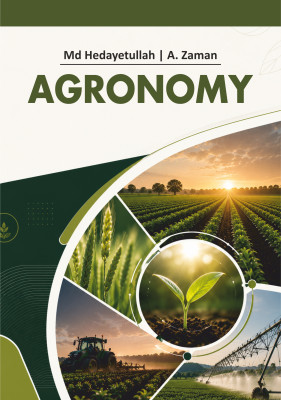
This book on Multiple Choice Questions (MCQs) in Agronomy has been carefully developed in accordance with the recommendations of the ICAR Sixth Dean’s Committee to provide comprehensive academic support for undergraduate and postgraduate students of agricultural sciences. Covering important subjects such as Dryland Agriculture, Rainfed Agriculture, Watershed Management, and Weed Management, the book is designed to strengthen conceptual understanding and improve examination readiness through a systematic collection of objective-type questions.
The content is aligned with the latest ICAR syllabus and reflects recent developments, technologies, and sustainable practices in agronomy. Each section includes topic-wise MCQs that help students evaluate their knowledge, develop analytical thinking, and gain confidence for competitive examinations, university assessments, and professional career opportunities in agriculture.
Special emphasis has been placed on integrating theoretical concepts with practical applications in real-world agro-ecological conditions. The book highlights contemporary agricultural challenges such as water conservation, climate resilience, integrated weed management, and sustainable crop production practices.
Prepared as a student-friendly learning resource, this book will also be valuable for teachers, researchers, extension workers, and aspirants preparing for agricultural competitive examinations. It aims to serve as a reliable guide for building a strong foundation in agronomy while encouraging scientific and sustainable approaches to modern agriculture.
Dr. Md Hedayetullah, Assistant Professor in Agronomy at Bidhan Chandra Krishi Viswavidyalaya, Mohanpur (West Bengal), is a dynamic and influential figure in contemporary agricultural science, bringing a distinctive blend of expertise spanning research, education, extension policy implementation, and grassroots development.
He also leads the ICAR’s All India Coordinated Research Project (AICRP) on Chickpea at the BCKV Centre. This pivotal leadership role places him at the forefront of national efforts to enhance pulse crops, driving the development of high-yielding, climate-resilient varieties and sustainable production technologies crucial for India’s nutritional security and farm profitability.
Dr. Hedayetullah earned his PhD in Agronomy from BCKV. His academic excellence was further recognized with the prestigious Maulana Azad National Fellowship, affirming his dedication to advanced scholarly inquiry and deep subject matter expertise.
His career reflects a comprehensive engagement across the agricultural ecosystem, consistently bridging the gap between scientific investigation and practical application. As an Agronomist at the National Bank for Agriculture and Rural Development (NABARD), he gained crucial insight into agricultural finance, rural credit mechanisms, and the economic policies shaping farm performance and rural development. As an Assistant Professor at the M.S. Swaminathan Institute of Agriculture Science, he focused on sustainable development goals, conducting applied research and implementing environmentally sound farming practices. As an Assistant Professor at the College of Agriculture, Tripura, he strengthened his commitment to academic instruction and mentorship, gaining a deep understanding of the challenges faced by emerging agricultural students and researchers.
A prolific author and dedicated mentor, Dr. Hedayetullah has guided 8 M.Sc. and 2 PhD students to successful completion. His scholarly contributions include 15 books (authored or co-authored), over 50 peer-reviewed research papers in leading national and international journals, and numerous specialized book chapters. He serves as Principal Investigator for several major externally funded research projects, demonstrating his ability to lead complex scientific initiatives. His commitment to outreach is reflected in his active participation in live television talks and impactful farmer training programs. Blending strong academic credentials, diverse experience in agricultural finance and field research, and a clear commitment to public engagement, Dr. Hedayetullah stands as an authoritative and inspiring guide for students beginning their journey in agricultural science.
Professor (Dr.) A. Zaman, PhD in Agronomy, is an internationally recognized scientist with 40 years of profound experience in agricultural water management. His groundbreaking and original research in fields such as irrigation water management, rainfed agriculture, cropping systems, watershed management, dry land agriculture, and biodiversity conservation has garnered global appreciation and established him as an outstanding teacher within farm universities worldwide. Dr. Zaman is credited with developing a wealth of original concepts, strategies, techniques, and tools that have profoundly contributed to agricultural science and benefited global society.
Born on May 27, 1954, he is a distinguished Agronomist specializing in Agricultural Water Management for enhancing crop and water productivity. His extensive career spans influential leadership roles at Bidhan Chandra Krishi Viswavidyalaya (BCKV) and Uttar Banga Krishi Viswavidyalaya (UBKV) in West Bengal, India. He has notably served as Dean, Faculty of Agriculture; Director of Research; Head of the Department of Agronomy; and Chief Scientist in AICRP on Water Management (ICAR). With significant research experience in water management, a background in post-graduate teaching, and considerable administrative acumen, he has contributed extensively to agricultural education and research.
Since May 2020, Prof. Zaman has served as the Dean of the School of Agricultural Sciences at Sister Nivedita University, Kolkata. His extensive professional journey includes pivotal roles as Founder In-charge of Agriculture at The Neotia University (June 2018 to 2020), Emeritus Professor in Agriculture at M.S. Swaminathan School of Agriculture, Centurion University of Technology and Management (September 2016 – May 2018), and Programme Coordinator for the World Bank-funded West Bengal Accelerated Development of Minor Irrigation Project (September 2014 – August 2016).
Prior to these roles, Dr. Zaman gained invaluable international experience as Head of the Irrigation Expatriate Team for the Government of Uganda (1994–1996) under an ITEC Programme. In this capacity, he was instrumental in designing, laying out, and installing farmer-managed small-scale irrigation systems for sustainable crop cultivation. His vast academic contributions include authorship of 10 textbooks in agriculture, several book chapters, over 150 peer-reviewed research papers, and 179 publications in national and international seminar and conference proceedings. Furthermore, he has significantly shaped future researchers, having guided 7 Ph.D. candidates and supervised over 50 postgraduate thesis works.
Chapter 1. Dryland Agriculture, Rainfed Agriculture and Watershed Management
Chapter 2. Basic Concepts of Dryland and Rainfed Agriculture
Chapter 3. MCQs on History of Dryland and Rainfed Agriculture in India
Chapter 4. Problems and Prospects of Dry Land and Rainfed Agriculture in India
Chapter 5. Soil and Climatic Conditions Prevalent in Dry Land and Rainfed Areas
Chapter 6. Length of Growing Period (LGP) in Dry Land and Rainfed Areas
Chapter 7. Soil Moisture Availability (SMA) and Impact on Cropping Systems
Chapter 8. Soil and Water Conservation Techniques
Chapter 9. Drought: Types, Effect of Water Deficit on Physio-Morphological Characteristics of the Plants
Chapter 10. Crop Adaptation and Mitigation to Drought
Chapter 11. Water Harvesting: Importance, Its Techniques
Chapter 12. Efficient Utilization of Water Through Soil and Crop Management Practices
Chapter 13. Crops and Cropping Systems in Dry Land Areas
Chapter 14. Crops and Cropping Systems in Rainfed Areas
Chapter 15. Management of Crops in Rainfed Areas
Chapter 16. Management of Crops in Dry Land Areas
Chapter 17. Contingent Crop Planning for Aberrant Weather Conditions
Chapter 18. Concept, History, Objective, Principles and Components of Watershed Management
Chapter 19. Factors Affecting Watershed Management
Chapter 20. Long Term Rainfall Analysis in Relation to Simple Mathematical Models and Forecasting the Weather Abnormalities
Chapter 21. Alternate Land Use System in Dry Land and Rainfed Areas
Chapter 22. Location, Regional and Crop Specific Dryland Principles and Practices for Profitable and Sustainable Dryland Farming and Allied Enterprises