Keywords
Agronomic Practices, Crop Production, Cropping Systems, Agronomy, Soil Fertility Management, Seed Science, Irrigation Management, Weed Management, Sustainable Agriculture, Green Manuring, Soil Moisture Conservation, Tillage Practices, Nursery Management, Seed Germination, Intercropping Systems, Multi-Storied Cropping, Indigenous Technical Knowledge, Water Management in Agriculture, Crop Classification, Sustainable Farming SystemsAgronomic Practices
authored by: Amit Kumar JhaLength: 229 mm | Breadth: 24.7 mm | Height: 152 mm | Imprint: CONTENT VIBES | Weight: GMS
This book will be available from 15-Jul-2026
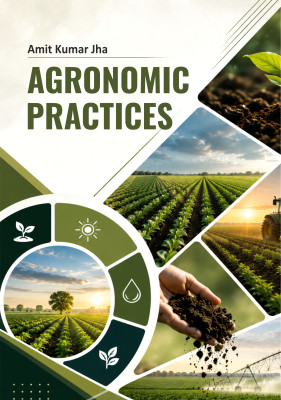
Agronomic Practices is a comprehensive textbook designed to provide students, researchers, and agricultural professionals with a clear understanding of the principles and practices involved in modern crop production and sustainable farming systems. The book covers fundamental topics such as crop classification, cropping systems, soil and climatic requirements, seed science, nursery management, tillage, sowing methods, irrigation, weed management, soil fertility, and moisture conservation. Special emphasis is given to integrated and eco-friendly agricultural approaches, including Indigenous Technical Knowledge (ITK), green manuring, multi-storied cropping, and alternate land use systems. Practical concepts related to resource use efficiency, crop interactions, and sustainable soil and water management are explained in a simple and systematic manner.
The book combines theoretical foundations with field-oriented applications to help readers understand real agricultural challenges and solutions. Written in an easy-to-understand style, it serves as a valuable resource for undergraduate students, competitive examinations, extension workers, and professionals involved in agronomy and sustainable agriculture.
Dr. Amit Kumar Jha was born on 29 June 1983 in Rewa district of Madhya Pradesh, India. He is a distinguished academician and researcher in the field of Agronomy.
Dr. Jha obtained his B.Sc. (Agriculture) in 2004, M.Sc. (Agriculture) in 2006, and Ph.D. in 2010 from Jawaharlal Nehru Krishi Vishwa Vidyalaya (JNKVV), Jabalpur, consistently demonstrating outstanding academic performance and merit-based scholarship throughout his studies.
He began his professional career as Scientist/Assistant Professor in the Department of Agronomy at JNKVV, Jabalpur in March 2011. Since then, he has made significant and sustained contributions to agricultural research, particularly in the areas of conservation agriculture, weed management, and forage agronomy. He has been actively engaged in multiple nationally and internationally funded research programmes, including AICRP on Forage Crops, AICRP on Chickpea, AICRP on Wheat, and an international collaborative project supported by the Japan International Cooperation Agency (JICA), along with several other Government of India and agency-sponsored initiatives.
Dr. Jha has been deeply involved in teaching undergraduate and postgraduate courses in Agronomy and has successfully guided 14 M.Sc. (Ag.) students, 6 M.Tech. students, and 5 Ph.D. scholars.
His research excellence is reflected in an extensive scholarly output, including over 130 research papers published in reputed national and international journals, 1 book, 2 review articles, 6 book chapters, 3 technical bulletins, 4 extension bulletins, 1 souvenir publication, 2 conference proceedings/abstract compilations, 21 extended summaries, 42 conference abstracts, and 9 popular articles aimed at farmer outreach and knowledge dissemination.
Dr. Jha’s scientific contributions have been widely recognized through several prestigious awards and honours, including the Young Scientist Award (Madhya Pradesh Council of Science and Technology, 2007), Best Paper Award (Indian Society of Weed Science, 2008), Kunwar Saxena Bahadur SRDA Award (2011), Best AICRP Centre Award (2013), Young Scientist Awards from the Indian Society of Weed Science (2014) and Rang Management Society of India (2014), AISA Gold Medal (2016), Associate Fellowship of the Rang Management Society of India (2017), Young Scientist Award from GKV Society, Agra (2017), and recognition by the Indian Society of Agronomy, Jabalpur. He has also received eight Best Oral and Poster Presentation Awards at various national and international scientific forums.
Dr. Jha continues to be an active contributor to agricultural science, with a strong commitment to research innovation, academic excellence, and sustainable agricultural development.
Chapter 1. Classification of Crops
Chapter 2. Origin, Distribution, and Economic Importance of Field Crops
Chapter 3. Soil and Climatic Requirements of Crops
Chapter 4. Definition and Scope of Cropping Systems
Chapter 5. Types of Cropping Systems
Chapter 6. Cropping System Indices and Yield Advantages
Chapter 7. Crop Interactions in Cropping Systems
Chapter 8. Multi-Storied Cropping Systems
Chapter 9. Special Purpose Crops
Chapter 10. Indigenous Technical Knowledge (ITK) in Crops and Cropping Systems
Chapter 11. Seeds: Types, Classification, and Varieties
Chapter 12. Seed Dormancy and Germination
Chapter 13. Nursery Management and Main Field Preparation
Chapter 14. Tillage Practices in Crop Production
Chapter 15. Seasons of India and Sowing Time
Chapter 16. Sowing and Planting Techniques
Chapter 17. Irrigation and Water Management
Chapter 18. Green Manuring and Soil Fertility Management
Chapter 19. Weed Management in Cropping Systems
Chapter 20. Soil Moisture Conservation and Alternate Land Use Systems