Keywords
Riverine ecology; Endangered fishes; Environmental flows; Habitat fragmentation; Fish passage; Riparian restoration; Sediment dynamics; Water quality; Invasive species; Overfishing; Climate resilience; Indigenous knowledge; Co-management; Ramsar sites; Biodiversity hotspots; Policy & legislation; Impact assessment; Community stewardship; Monitoring & indicators; Adaptive management.Fish and River Ecosystems of India
edited by: Rinkesh, Zaheer Abass, Durgesh Kumar VermaLength: 152 mm | Breadth: 11.9 mm | Height: 229 mm | Imprint: CONTENT VIBES | Weight: 600 GMS
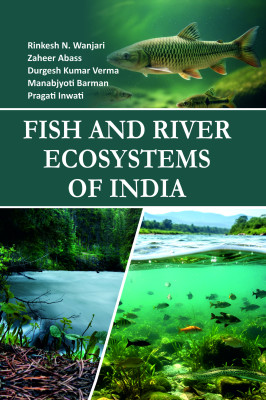
This book offers a rigorous, India-centric guide to conserving endangered fishes across riverine ecosystems. Beginning with an introduction to the Indian river system and the ecological characteristics that shape flow, habitat mosaics, and connectivity, it explains the ecological roles of fishes—as bioindicators, nutrient cyclers, and keystone links—within lotic food webs. Dedicated chapters analyze human pressures (dams, sand mining, pollution, invasive species, overfishing) and synthesize emerging evidence on climate-change impacts on hydrology, temperature regimes, migration cues, and species distributions.
Bridging science and practice, the volume maps India’s major river basins and their fish diversity, highlights Ramsar sites and biodiversity hotspots, and interprets how these designations contribute to global conservation outcomes. It demystifies legislation and policy frameworks—from protected-area instruments to environmental flow standards—translating compliance requirements into field actions. Community knowledge is woven throughout, showing how indigenous practices, seasonal calendars, and customary norms can strengthen co-management and restoration outcomes. The book closes with future directions that integrate robust science, policy reform, finance, and community stewardship, supported by case studies of river-habitat restoration and species-recovery successes.
Key Features
-
India-focused river ecology with global framing
-
Threat diagnostics linked to actionable mitigation
-
Policy and compliance translated for practitioners
-
Indigenous knowledge integrated with modern science
-
Restoration case studies and monitoring templates
-
Forward-looking roadmap for basin-scale governance
Rinkesh Nemichand Wanjari completed his Ph.D. from SKUAST-Kashmir, India in the department of Fisheries Resource Management and Master of Fisheries Science (M.F.Sc) degree in the department of Fisheries Resource Management in 2020 from ICAR-Central Institute of Fisheries Education, Mumbai. Currently he is working as a Guest Faculty at College of Fishery Science, Nagpur (MAFSU-University). He has qualified for ICAR-JRF (2020), ICAR-NET (2021 & 2023) and ICAR SRF (2021). He has published many research papers, abstracts, book chapters, and popular articles. He has participated and presented papers at many national and international conferences and attended various training programs/ workshops. Notably, he was awarded including best poster presentation, and Junior Scientist Award.
Zaheer Abass is currently pursuing his PhD at Sher-e-Kashmir University of Agricultural Sciences and Technology Kashmir (SKUAST). He also completed his Master of Fisheries Science (M.F.Sc) in Fisheries Resource Management from the ICAR-Central Institute of Fisheries Education, Mumbai. Mr. Zaheer Abass has qualified for the ICAR-JRF (2020), ICAR-NET (2023), and ICAR-SRF (2022). He has been awarded a National Fellowship and Scholarship for Higher Education of ST Students to pursue a Ph.D. degree in 2023. He has his specialisation in Fish Taxonomy, Fishing Technology, fish conservation and management and Geo-spatial tools (QGIS). He has published many research papers, abstracts, book chapters, and popular articles. He has presented at numerous national and international conferences and participated in various training programs and workshops.
Durgesh Kumar Verma completed his B.F.Sc. & M.F.Sc. in Fisheries Resource Management from the Acharya Narendra Deva University of Agriculture and Technology, Kumarganj Ayodhya, India. He has authored/published several research and review papers, popular articles, chapters, and books. He is an active and dedicated member of several professional societies, mainly engaged in fisheries research and development in the country. He has received several accolades at national and international meetings, including the Junior Researcher Award, Young Scientist Award, and Best Paper Presentation awards.
Chapter 1 Conservation Strategies: Protecting Endangered Fish Species in Riverine Ecosystem
Chapter 2 Ecological Characteristics of Indian Rivers
Chapter 3 Ecological Role of Fish in River Ecosystems
Chapter 4 Future Directions: Integration of Science, Policy, and Community Efforts
Chapter 5 Human Activities and their Effects on River Fish Populations
Chapter 6 Impacts of Climate Change on Riverine Fish Diversity
Chapter 7 Indian River Systems and Their Fish Diversity
Chapter 8 Indigenous Knowledge and Fish Conservation
Chapter 9 Introduction to the Indian River System
Chapter 10 Legislation and Policy Framework for River Conservation
Chapter 11 Ramsar Sites; Biodiversity Hotspots and their Role in Global Conservation
Chapter 12 Restoration of River Habitat Case Studies and Success Stories