Keywords
Generative AI in Education, AI Content Generation for Learning, AI-Based Assessment and Feedback, LLM Chatbots in Education, Virtual Teaching Assistants, AI Curriculum Development, Lesson Planning with AI, Digital Pedagogy and AI Integration, Assistive EdTech for Disabled Students, AI for Inclusive Education, AI-Generated Educational Games and Simulations, Student Engagement through AI, Responsible AI in Education, Ethical AI in Teaching, AI Integration with LMS, AI-Powered Educational Tools, Teacher Productivity with AI, AI for Academic Institutions, Education 5.0 and Generative Intelligence, Real-World Applications of AI in EducationGenerative AI in Education: Future of Learning
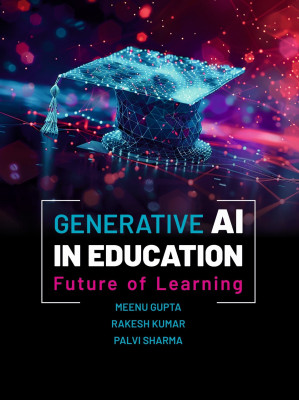
edited by: Meenu Gupta, Rakesh Kumar & Palvi SharmaLength: 22.9 mm | Breadth: 14.36 mm | Height: 2.960 mm | Imprint: NIPA | Weight: GMS
This book will be available from 17-Jul-2026
Generative AI in Education: Future of Learning explores how Generative Artificial Intelligence is transforming teaching, learning, and assessment. The book presents foundational concepts of GenAI and its role in creating personalized, adaptive learning experiences and intelligent educational content. It highlights AI-powered tools such as virtual teaching assistants, automated feedback systems, and curriculum design support. Emphasizing inclusivity, it discusses solutions for diverse learners and creative engagement through simulations and storytelling.
The book also addresses ethical concerns, data privacy, and responsible AI use. With insights into Education 5.0 and real-world case studies, it serves as a valuable guide for educators, researchers, policymakers, and students.
Dr. Meenu Gupta (Stanford/Elsevier’s Top 2% Scientist, 2025) is a Professor and Head of Conferences & Research Outreach (Engineering Cluster) in the UIE-CSE Department at Chandigarh University, India. She is currently pursuing her Postdoctoral Fellowship at the MIR Lab, USA, and holds a Ph.D. in Computer Science and Engineering from Ansal University, Gurgaon (2020).
With over 17 years of teaching and research experience, her expertise spans Machine Learning, Intelligent Systems, Data Mining, Artificial Intelligence, Image Processing, Smart Cities, Data Analysis, and Brain–Machine Interaction (BMI). Dr. Gupta has edited more than 22 books and authored four engineering books. She has published over 250 research papers in reputed international journals and conferences, along with 45+ book chapters.
She actively serves as a reviewer for several high-impact journals, including Big Data, Artificial Intelligence Review, Scientific Reports, CMC, and Digital Health. She is a Senior Member of IEEE, a Life Member of ISTE and IAENG, and currently serves as an Executive Committee Member of the IEEE Delhi Section as well as an Advisor to the IEEE RAS Chapter. Dr. Gupta has also organized numerous conferences technically sponsored by IEEE Delhi Section, IEEE CIS, AIP, and others, significantly contributing to research outreach and collaborations.
Dr. Rakesh Kumar is an Associate Director in the UIE-CSE Department at Chandigarh University, Punjab, India. He is currently pursuing his Postdoctoral Fellowship at the MIR Lab, USA. He completed his Ph.D. in Computer Science and Engineering from Punjab Technical University, Jalandhar, in 2017.
With more than 22 years of teaching experience, his research interests include IoT, Machine Learning, and Natural Language Processing. He has edited over 12 books with reputed publishers such as Elsevier, Springer, and Taylor & Francis, and has authored five books.
Dr. Kumar serves as a reviewer for several reputed journals, including Big Data, CMC, Scientific Reports, TSP, Multimedia Tools and Applications, and IEEE Access. He is a Senior Member of IEEE and has authored or co-authored more than 200 publications in national and international journals and conferences. He has also organized and edited numerous international conferences under the aegis of IEEE and AIP.
Dr. Palvi Sharma is an Assistant Professor in the School of Computing Engineering & Applications at GLA University, Mathura, with over six years of teaching and research experience. She earned her Ph.D. in Computer Science and Engineering from Chandigarh University, with a research focus on road extraction from remote sensing images using deep learning techniques.
She completed her M.Tech from Shri Mata Vaishno Devi University and her B.Tech from Baba Ghulam Shah Badshah University. Dr. Sharma has published several papers in Scopus-indexed conferences and reputed ESCI/SCI journals and has contributed six book chapters to international publications.
She has reviewed over 50 research papers, organized conferences, chaired technical sessions, and guided more than 50 student projects. Her areas of expertise include Machine Learning, Deep Learning, Remote Sensing, IoT, and Smart City applications. Her current research interests focus on AI-driven institutional inspection systems, smart agriculture, and data-driven healthcare solutions.
Chapter 1.Foundation of Generative AI and its Evolution in Education
Chapter 2.Redesigning Education Content Generation through Generative AI
Chapter 3.Assessment, Evaluation, and Feedback through Generative AI
Chapter 4.Virtual Teaching Assistant: LLM-Powered Chatbots and Tutors
Chapter 5.AI-Augmented Design for Curriculum Development and Lesson Planing
Chapter 6.Smart Support to Bridge Gaps: The Synergy of Digital Pedagogy, Assistive Edtech, and Generative AI for Disabled Students
Chapter 7.AI-Generated Games, Stories, and Simulations to Increase Student Involvement and Creativity
Chapter 8.Ensuring Responsible Application of Generative AI in Education.
Chapter 9.Integrating Generative Artificial Intelligence with Learning Management Systems and Educational Tools
Chapter 10.Empowering Teachers with Generative Ai: Reducing the Workload and Promoting Creativity
Chapter 11.Education 5.0: The Future of Education in The Era of Generative Intelligence
Chapter 12.Real-World Applications and Case Studies of Generative AI in Academic Institutions