Keywords
Artificial Intelligence in Healthcare, Internet of Medical Things (IoMT), AIoMT, Medical Device Networks, Machine Learning, Deep Learning, Reinforcement Learning, Healthcare Cybersecurity, Medical Data Analytics, Predictive Diagnostics, Telemedicine,,Smart Wearables Robotic-Assisted Surgery, Medical Sensors, Edge Computing in Healthcare, Cryptographic Protocols, Adversarial Attacks, Biomedical Engineering, Remote Patient Monitoring, Intelligent Healthcare SystemsArtificial Intelligence Enabled Internet of Medical Things: Smart Medical Systems and Patient-Centred Care
authored by: Wasswa ShafikLength: 152 mm | Breadth: 12 mm | Height: 229 mm | Imprint: NIPA | Weight: 600 GMS
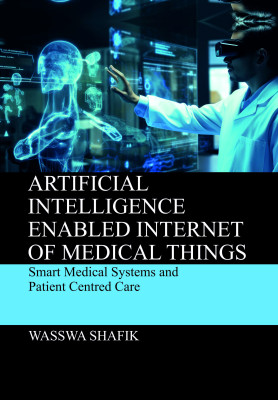
This book offers a comprehensive and technically rigorous exploration of the rapidly evolving field of Artificial Intelligence–enabled Internet of Medical Things (AIoMT). It presents a multidimensional examination of how AI methodologies and interconnected medical devices are transforming modern healthcare ecosystems into intelligent, autonomous, and data-driven systems.
The volume covers the complete lifecycle of AIoMT systems, beginning with their conceptual evolution and foundational architectures, followed by the electronic components, communication protocols, and network infrastructures that power intelligent medical devices. It delves deeply into the integration of machine learning, deep learning, and reinforcement learning into IoMT frameworks, enabling predictive diagnostics, autonomous decision-making, and personalized clinical interventions.
A major emphasis is placed on cybersecurity, providing in-depth analyses of system vulnerabilities, threat vectors, adversarial attacks, and robust cryptographic techniques. The book proposes actionable security and resilience strategies to ensure data integrity, patient privacy, and dependable system performance in real-world scenarios.
In addition to theoretical foundations, the volume presents empirical case studies demonstrating AIoMT deployment in areas such as medical imaging, robotic-assisted surgery, telemedicine, smart wearables, and remote patient monitoring. It further discusses benchmarking methodologies, validation techniques, and real-world implementation challenges.
Concluding with future directions, ethical considerations, and standardization needs, this book serves as an essential resource for AI researchers, biomedical engineers, IoT developers, healthcare technologists, clinical innovators, and policymakers engaged in shaping next-generation intelligent medical infrastructures.
Wasswa Shafik is an IEEE member and Team Lead at the Dig Connectivity Research Laboratory (DCRLab) in Kampala, Uganda. He holds a PhD in Computer Science from the School of Digital Science, Universiti Brunei Darussalam. Wasswa also earned a Master’s degree in Information Technology Engineering from Yazd University, Iran, and a Bachelor’s degree in Information Technology from Ndejje University, Uganda. Wasswa has received specialized training from the National Institutes of Health (NIH), the U.S. Department of Health and Human Services, and the Bloomberg School of Public Health, focusing on Data Quality, Monitoring and Evaluation Fundamentals, and Protecting Human Research Participants. Before his PhD, he worked as a Community Data Officer at Pace-Uganda, a Research Associate at TechnoServe and Mercy Corps, a Research Assistant at PSI-Uganda, a Research Lead at the Socio-economic Data Centre (SEDC-Uganda), and a former Agricultural Managing Director at Asmaah Charity Organisation. His research focuses on developing computationally efficient models for challenges in health, agriculture, and ecology. He specializes in Artificial Intelligence, Computer Vision, Neural Networks, and the Internet of Things, with applications in Smart Agriculture, Digital Health, and Ecological Informatics.
Chapter 1: Historical Perspectives of AIoMT
Chapter 2: AIoMT Communication and Networks
Chapter 3: AIoMT Devices and Protocols
Chapter 4: Electronics Devices in AIoMT
Chapter 5: AIoMT Application Domains
Chapter 6: AIoMT Concerns
Chapter 7: AIoMT Risks
Chapter 8: AIoMT Challenges
Chapter 9: Cyber-Attacks Against AIoMT
Chapter 10: AIoMT Security Measures
Chapter 11: Recommendations Towards Securing AIoMT Systems
Chapter 12: AIoMT for Recording and Processing Medical Information
Chapter 13: AIoMT Enabling Medical Image Processing
Chapter 14: Application of AIoMT in Medical Robotics
Chapter 15: AIoMT Enabling Telemedicine
Chapter 16: AIoMT in Hospital Information Systems Management
Chapter 17: AIoMT Enabling Secure Communication of Medical Systems
Chapter 18: AIoMT Training, Testing, and Validation
Chapter 19: AIoMT Enabling Teaching and Learning
Chapter 20: Case Studies in AIoMT Application
Chapter 21: Future Directions of AIoMT Application