Keywords
Drought Vulnerability, Drought Prone Area Delineation, Meteorological Drought,Agricultural Drought, Hydrological Drought, Drought Monitoring Systems, Early Warning Indicators, Remote Sensing for Drought Assessment, Soil Moisture Deficit, Climate Change Impacts, Atmospheric Drought, Water Resource Management, Livestock Drought Adaptation, Hydropower Generation Risks, Urban Water Stress, Sustainable Irrigation Practices, Global Drought Mitigation Initiatives, Community-Based Adaptation, Policy and Governance in Drought Management, Climate-Resilient AgricultureDroughts Through the Ages: Insights for a Resilient Future
authored by: Surender Singh, B V Ramana Rao & VUma Maheswara RaoLength: 152 mm | Breadth: 15 mm | Height: 229 mm | Imprint: NIPA | Weight: 580 GMS
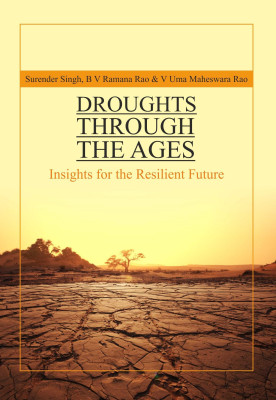
Droughts through the Ages: Insights for a Resilient Future offers a comprehensive exploration of one of the most persistent and complex natural hazards affecting ecosystems, agriculture, water resources, and human livelihoods. This book provides an interdisciplinary and forward-looking perspective on droughts—from historical understanding to modern-day challenges, and pathways toward building resilience.
Beginning with an overview of drought-prone area delineation, the book discusses the changing nature and intensity of droughts in the 21st century, backed by scientific insights into their impacts on agriculture, water, urban systems, and energy. It offers a detailed classification of droughts meteorological, hydrological, agricultural, and atmospheric—highlighting their distinct characteristics and overlapping consequences. Special attention is given to drought monitoring, early warning systems, and the development of alerts, emphasizing the critical role of timely data, remote sensing, and agrometeorological tools. Drawing on global frameworks such as the Integrated Drought Management Program, the Sendai Framework for Disaster Risk Reduction and insights from the World Meteorological Organization, the authors emphasize the need for integrated, science-based, and locally tailored drought preparedness. The book presents robust strategies for drought management in agriculture, water systems, and urban environments, while also addressing livestock production and hydroelectric power generation under water-scarce conditions.
Chapters on climate change and atmospheric drought examine emerging risks and the intensification of drought events under global warming scenarios. The book advocates for sustainable water management strategies and draws on global initiatives and successful case studies that highlight innovation and cooperation in drought risk reduction. Equally important are chapters on public awareness, emphasizing the need to empower farmers and communities through agrometeorological knowledge, and the indispensable role of policy support in translating science into action. Concluding with insights for a resilient future, the book serves as a vital resource for researchers, educators, development professionals, and policymakers seeking integrated approaches to understanding, mitigating, and adapting to droughts in a changing world.
Surender Singh brings with him over thirty-five years of distinguished experience in the field of agrometeorology, marked by excellence in teaching, research, outreach, and academic administration. He earned his PhD in Agrometeorology under the mentorship of Dr V Uma Maheswara Rao and has served in various esteemed capacities at Chaudhary Charan Singh Haryana Agricultural University, Hisar, India including Principal Scientist, Professor & Head, Senior Scientist, Assistant Scientist, Advisor (Recruitments), and Assoc Director (Students’ Counseling and Placement). A meritorious scholar, he is the recipient of two Gold Medals-one for Best Research Work during his doctoral program, and the other for the Best PhD Dissertation, awarded by the then President of India, Dr APJ Abdul Kalam. He was twice offered the prestigious UK Universities Vice Chancellors’ Scholarship under the Commonwealth Fellowship Program for higher studies. His international academic journey includes post-doctoral fellowships at the International Centre for Theoretical Physics, Trieste, Italy; Instituto Agronômico, Campinas, Brazil; and BOKU-Met – Institute of Meteorology and Climatology, Vienna, Austria.
Dr Singh is a life member of numerous professional societies, including the Association of Agrometeorologists, Indian Meteorological Society, Indian Society of Remote Sensing, International Society for Agrometeorology, Society for Sustainable Agriculture and Resource Management, ESPERE, European Drought Centre and SAFOAM. He has organized several national-level trainings, seminars, and symposia in Agrometeorology and allied fields. His academic contributions include over 250 publications, encompassing research papers, popular articles, manuals, teaching aids, and book chapters. In addition, he has authored 30 books and monographs, along with numerous technical and scientific bulletins. He has served as Managing Editor of the Journal of Agrometeorology, Vice President of Association of Agrometeorologists and contributed internationally as Research Collaborator with MARCO (Japan) and SPARC, ETH Zurich (Switzerland). His expertise has been recognized globally, with appointments to the Expert Team on Agrometeorology (CAgM-WMO, Geneva) from 2018 to 2020, and as a Core Committee Member on Agriculture-Drought at WMO, Geneva for two consecutive terms (2021–24 and 2024–27). He also serves as an External Expert for Research Project Evaluation at the COST Association, European Union, Brussels. A dedicated mentor, Dr. Singh has guided numerous undergraduate, postgraduate, and doctoral students who now serve in prominent positions across India. Widely traveled, he has represented India across the globe in academic and scientific forums. In recognition of his exemplary achievements and enduring impact on agrometeorological science, he was conferred the prestigious title of Fellow of the Association of Agrometeorologists (FAAM) in 2024.
BV Ramana Rao has been a towering figure in the field of Agricultural Meteorology, with a distinguished career spanning over four decades. He began his academic journey at the University of Agricultural Sciences, Bangalore, where he taught Agricultural Meteorology from 1966 to 1979. Subsequently, he joined the Indian Council of Agricultural Research and served in various key capacities until his superannuation in April 2000. He held the position of Head, Division of Climatology, Wind Power, and Solar Energy Utilization at ICAR- CAZRI, Jodhpur, and later became the Founder Project Coordinator of the pioneering AICRP on Agrometeorology, ICAR-CRIDA, Hyderabad, from December 1984 to March 1994.
Professor Rao’s contributions to the advancement of agrometeorology are both foundational and transformative. His research significantly shaped key areas such as agroclimatic characterization, delineation of efficient cropping zones, crop-weather modeling, classification and management of agricultural droughts, and operational agrometeorology. He has published over 150 research papers, including 50 papers in high-impact international journals, reflecting his global scientific standing. In addition, he has authored 20 books and monographs, along with numerous technical and scientific bulletins. He served with distinction as the Editor-in-Chief of the Journal of Agrometeorology for an impressive 14 years (2009–2023), elevating the journal’s stature and influence in the global agrometeorological community. He was awarded the prestigious British Council Fellowship (1986–87) for advanced training at the University of Reading, UK. In recognition of his lifelong contributions to the field, he was honored with the title of Honorary Fellow (2011) and conferred the Lifetime Achievement Award (2025) by the Association of Agrometeorologists.
V Uma Maheswara Rao is a seasoned expert in Agrometeorology, with over four decades of extensive experience in teaching, research, extension, and academic administration. He holds a PhD in the broad field of Agrometeorology and has served in various distinguished roles including Project Coordinator, Principal Scientist, Professor & Head, Agrometeorologist, and Assistant Scientist at CCS Haryana Agricultural University and under the Indian Council of Agricultural Research (ICAR). Throughout his career, Dr Rao has been instrumental in shaping the growth and direction of agrometeorological science in India. He has actively contributed to the development and dissemination of agrometeorological knowledge by organizing and leading numerous national and international training programs, workshops, and capacity-building initiatives, aimed at empowering students, researchers, and field professionals alike. He is a life member of several esteemed professional and scientific organizations, including the Indian Meteorological Society, The Arid Zone Research Association of India, Indian Society of Remote Sensing, Association of Agrometeorologists, International Society for Agrometeorology and The Indian Society of Dryland Agriculture. He has served as President of Association of Agrometeorologists also.
With an exceptional academic footprint, he has authored and published more than 345 scholarly contributions, including research papers, popular articles, manuals, teaching aids, bulletins, and book chapters. In addition, he has authored 35 books and monographs, along with numerous technical and scientific bulletins. His leadership and expertise were globally acknowledged when he served as a member of the CCl-ET-IIC of the World Meteorological Organization, Geneva (2014–2017). He was also appointed to the XI Plan High Powered Review Committee of the MoES, Govt of India, in 2012. In recognition of his visionary leadership, the prestigious Chaudhary Devi Lal Award for the Best AICRP on Agrometeorology was conferred by ICAR in 2014, under his stewardship as Project Coordinator. A passionate mentor, he has guided a large number of undergraduate, postgraduate, and doctoral students, many of whom now hold key positions across the country in the domain of Agrometeorology. His professional engagements have taken him to numerous countries, representing India in various scientific forums and collaborative projects. His vast experience, dedication to education, and deep commitment to agrometeorological research continue to inspire the next generation of scientists and practitioners.
Chapter 1.Introduction
Chapter 2.Drought Prone Area Delineation
Chapter 3.Droughts in 21st Century and Impacts
Chapter 4.Classification of Droughts
Chapter 5.Drought Monitoring
Chapter 6.Droughts: Early Warning and Alerts
Chapter 7.Agricultural Drought Management
Chapter 8.Hydrological Drought Management
Chapter 9.Urban Drought Management
Chapter 10.Climate Change and Atmospheric Drought
Chapter 11.Droughts and Livestock Production
Chapter 12.Droughts and Hydroelectric Power Generation
Chapter 13.Sustainable Water Management Strategies
Chapter 14.Global Initiatives for Alleviating the Impact of Droughts
Chapter 15.Public Awareness - Empowering Communities and Farmers through Agrometeorological Knowledge
Chapter 16.Policy Support
Chapter 17.Insights for Resilient Future