Keywords
Blockchain in Agriculture, Agri-Food Blockchain Systems, Agricultural Blockchain Technology, Smart Agriculture Governance, Blockchain-Based Supply Chain, Food Traceability Systems, Sustainable Agri-Food Systems, Smart Contracts in Agriculture, Agricultural Data Security, Decentralized Agricultural Systems, Food Safety and Transparency, Blockchain for Food Security, Digital Agriculture Transformation, Precision Agriculture Technologies, Agricultural Policy and Governance, IoT and Blockchain Integration, Agricultural Sustainability, Blockchain-Based Crop Insurance, Transparent Food Supply Chains, AgriTech and Distributed Ledger TechnologyBlockchain Technology for Agriculture: Decentralized Systems, Governance, Security and Applications
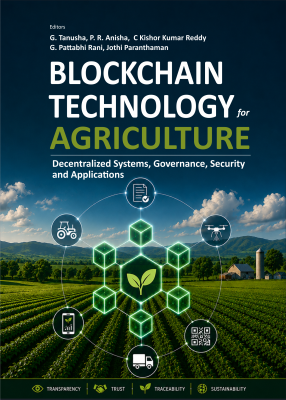
edited by: G. Tanusha, P. R. Anisha, C Kishor Kumar Reddy, G. Pattabhi Rani & Jothi ParanthamanLength: 152 mm | Breadth: 23.5 mm | Height: 229 mm | Imprint: NIPA | Weight: 1060 GMS
This book will be available from 12-Aug-2026
Modern agricultural supply chains consist of many interconnected players, from farmers and processors to distributors and retailers, which makes it tough to keep track of everything. Keeping accurate product tracking, preventing fraud, ensuring food safety, and adhering to regulations are ongoing challenges, especially since traditional centralized systems offer limited transparency and can be easily manipulated.Blockchain technology brings in a decentralized and tamper proof digital ledger that boosts accountability and traceability throughout the supply chain. When paired with technologies like IoT sensors, RFID tags, and programmable smart contracts, blockchain can enable secure data recording, automate transaction validation, and ensure trustworthy product origins. This chapter provides a thorough yet practical look at blockchain-enabled traceability frameworks, covering system architecture, smart contract design, security measures, and real-world case studies, giving useful insights for researchers, industry players, and policymakers who are looking forscalable and dependable agricultural traceability solution.
Mrs. G. Tanusha, Assistant Professor in the Department of Artificial Intelligence and Machine Learning, Stanley College of Engineering and Technology for Women, Hyderabad, India, with one year of teaching experience and research experience. She has Published 2 research papers, and 2 International Conferences, and 4 Book Chapters for edited books indexed by Scopus and others. She is a member in ACM.
Dr. P. R. Anisha is an Associate Professor in the Department of Computer Science & Engineering at Stanley College of Engineering and Technology for Women, Hyderabad, with over nine years of teaching and research experience. She holds a PhD from K L University and has published more than 50+ research papers in reputed international journals and conferences. Her research interests include Artificial Intelligence, Machine Learning, Image Processing, IoT, and data-driven healthcare. She has served as a Special Session Chair at various national and international conferences and is an active member of professional bodies such as ACM and IAENG. She has also co-authored books on C and C++ programming and is recognized as a motivational speaker, contributing significantly to academic and professional communities.
Dr. C Kishor Kumar Reddy, currently working as Professor, Dept. of Computer Science and Engineering, Stanley College of Engineering and Technology for Women, Hyderabad, India. He has research and teaching experience of more than 12 years. He has published more than 250+ research papers in National and International Conferences, Book Chapters, and Journals indexed by Scopus and others. He is an author for 2 text books and 35+ edited books. He is a member of ISTE, CSI, IAENG, UACEE, IACSIT. His research areas include: Bioinformatics, NeuroScience, Remote Sensing, Deep Learning, Intelligent Systems.
Dr. G. Pattabhi Rani is an Assistant Professor in the Department of Computer Science & Engineering at Government College of Engineering, Sengipatti, Thanjavur. She holds PhD from Annamalai University and has published 7 research papers in reputed journals. Her research interests span Image Processing and Networking.
Dr. Jothi Paranthaman is an accomplished academic and researcher currently serving as a faculty member in the Faculty of Engineering and Technology at Botho University. With a strong background in engineering and applied sciences, her areas of expertise include smart technologies, computational modeling, and interdisciplinary applications in engineering education. She has contributed to several research projects, academic publications, and curriculum development initiatives aimed at integrating technology-driven solutions into teaching and real-world problem-solving. Dr. Paranthaman is committed to fostering innovation and excellence in engineering education across emerging domains.
Chapter 1. Evolution of Digital Agriculture and the Need for Decentralized Systems
Chapter 2. Farmer Producer Organisations as Institutional Enablers of Blockchain Technology Adoption in Agriculture
Chapter 3. Polygon Network Architecture: Layer-2 Design, Consensus, and Scalability
Chapter 4. Decentralized Identity and Access Control for Agricultural Stakeholders
Chapter 5. Secure Data Sharing and Interoperability with Government and Enterprise Systems
Chapter 6. Blockchain-Enabled Input Distribution and Smart Subsidy Management for Transparent Agricultural Governance
Chapter 7. Smart Contract–Based Crop Insurance and Risk Management
Chapter 8. Blockchain Applications for Quality Certification and Food Safety
Chapter 9. Performance Evaluation of the Polygon Network Under Agricultural Workload Conditions
Chapter 10. Comparative Analysis of Ethereum and Polygon for Agri-Blockchain Systems
Chapter 11. Security, Privacy, and Regulatory Challenges in Agricultural Blockchain Systems
Chapter 12. Implementation Framework for Blockchain-Based Digital Agriculture and Decentralized Data Ecosystems