Keywords
Micrometeorology in Agriculture, Agricultural Microclimate Management, Atmospheric Boundary Layer Studies, Solar Radiation and Crop Growth, Wind Patterns in Crop Production, Soil and Air Temperature Dynamics, Rainfall Variability in Farming, Humidity and Atmospheric Pressure Effects, Photosynthesis and Climate Interaction, Evapotranspiration in Agriculture (ET Models), Remote Sensing in Agrometeorology, Climate Smart Agriculture Techniques, Microclimate Management in Horticulture, Livestock Microclimate Optimization, Forest Micrometeorology Studies, Protected Cultivation Microclimate (Greenhouse Climate Control), Topographical Influence on Microclimate, Vedic Agriculture and Traditional Weather Knowledge, Climate Change Adaptation in Farming, Micrometeorological Concepts for Climate Change (MCCC)Climate Change and Micrometeorology of Crops and Livestock
authored by: V. Radha Krishna MurthyLength: 152 mm | Breadth: 20 mm | Height: 229 mm | Imprint: NIPA | Weight: 620 GMS
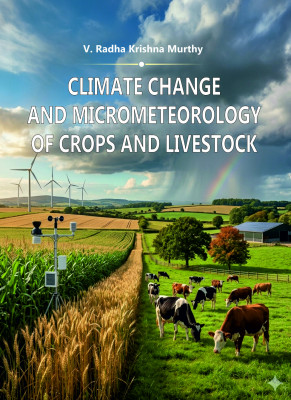
Rooted in four decades of research, field experience, and deep reverence for nature, Climate Change and Micrometeorology of Crops and Livestock presents a transformative, farmer-centric vision of climate-resilient agriculture. Introducing innovative concepts such as PCCC, MCCC, and CCAC, the book bridges science, policy, and grassroots practice to enhance productivity, quality, and sustainability. It harmonizes modern technologies with Vedic wisdom, emphasizing the sacred relationship between soil, weather, crops, and livestock.
Designed for scientists, policymakers, and farmers alike, this work inspires integrated, practical solutions to climate change while promoting dignity, resilience, and sustainable rural livelihoods.
Dr. Murthy is a globally recognized agrometeorologist and internationally acclaimed expert in climate-resilient agriculture, known for his pioneering work on “Weather, Health, and Agriculture,” bridging the intersection of climate change and sustainable agriculture.A former Senior Professor and Head with nearly four decades of experience in agrometeorology, climate change, and agriculture, he has significantly influenced research, teaching, policy, and grassroots applications.
Dr. Murthy holds degrees in B.Sc. (Agriculture), M.Sc. (Agrometeorology), Ph.D. (Agronomy), and a Postgraduate Diploma in Environmental Studies, and was a merit scholarship holder throughout his academic career.
He has served as an expert team member for committees of the World Meteorological Organization and has participated as an international expert in roving seminars on “Weather–Climate–Farmers.”He is a recipient of CSIR Fellowship and FAO–ICAR–ANGRAU Fellowship awards and has received Best Teacher Awards at multiple levels.Dr. Murthy has developed several innovative concepts, including climate change policy frameworks, micrometeorological approaches, blended weather technologies, and practical tools such as web-based GDD calculators, rainfall constants, and technologies for winter paddy nurseries.
An accomplished author, he has written nine books and manuals in agrometeorology, fourteen books on agricultural education, and seven international book chapters, along with more than 225 peer-reviewed scientific publications.This book reflects his lifelong commitment to building informed, resilient, and climate-conscious agricultural leaders and stands as a significant contribution to contemporary agricultural science.
Chapter 1.From Cosmic Rays to Crop Canopies: Introduction to Micrometeorology
Chapter 2.Atmospheric Boundary Layer and Micrometeorology
Chapter 3.Solar Radiation and Micrometeorology
Chapter 4.Wind and Micrometeorology
Chapter 5.Air and Soil Temperature and Micrometeorology
Chapter 6.Rainfall and Micrometeorology
Chapter 7.Humidity, Pressure, and Micrometeorology
Chapter 8.Cultivated Soil, Photosynthesis, and Micrometeorology
Chapter 9.Evapotranspiration (ET) and Micrometeorology
Chapter 10.Remote Sensing and Micrometeorology
Chapter 11.Microclimate Management in Agriculture
Chapter 12.Microclimate Management in Horticulture
Chapter 13.Microclimate Management in Livestock
Chapter 14.Microclimate management in Forests
Chapter 15.Micrometeorology of Topographical Features
Chapter 16.Micrometeorology of Protected Cultivation Structures
Chapter 17.The farmer’s Ancient/ Vedic and Classical Micrometeorological
Chapter 18.Micromet Concept for Climate Change (MCCC)