Keywords
Machine Learning applications,Artificial Intelligence in healthcare,Deep learning research papers,AI-based disease prediction,Solar power forecasting using LSTM,IoT cybersecurity and botnet detection,Skin disease detection using AI,Cardiac disease prediction models,AI in newable energy systems,Smart healthcare analytics,Deep learning in medical diagnosis,Predictive nalytics in healthcare,AI for crop disease detection,Sleep disorder classification using machine learning,Edge AI in cybersecurity,Hybrid deep learning models,AI in education and student retention,Computer vision in medical imaging,Data-driven health risk prediction,Intelligent systems and machine learning researchArtificial Intelligence and Machine Learning Methods for Engineering Systems: Forecasting and Mathematical Insights
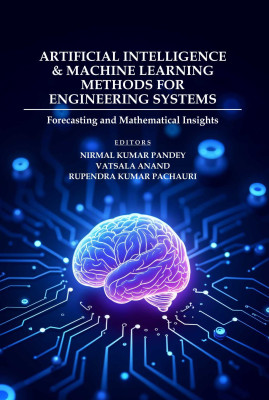
edited by: Nirmal Kumar Pandey,Vatsala Anand & Rupendra Kumar PachauriLength: 152 mm | Breadth: 12.6 mm | Height: 229 mm | Imprint: NIPA | Weight: 440 GMS
This book presents a comprehensive exploration of advanced Artificial Intelligence and Machine Learning applications across diverse real-world domains. It brings together cutting-edge research in healthcare, renewable energy, cybersecurity, agriculture, and human behavior analytics, demonstrating how intelligent systems are transforming modern society. The volume covers deep learning architectures, predictive modeling, IoT security frameworks, medical diagnosis systems, and energy forecasting techniques, offering both theoretical foundations and practical implementations.
With contributions from contemporary research, the book highlights innovative solutions such as disease prediction systems, solar energy forecasting using LSTM networks, AI-based intrusion detection, and smart healthcare analytics. It also emphasizes hybrid models, edge AI, and data-driven decision-making approaches.
Designed for researchers, academicians, industry professionals, and postgraduate students, this book serves as a valuable resource for understanding how AI-powered technologies are shaping the future of intelligent systems and sustainable innovation across multiple disciplines.
Dr. Nirmal Kumar Pandey is an Assistant Professor at Haridwar University, India. He holds a Ph.D. in Electrical and Electronics Engineering from UPES, where his research focused on the design and analysis of controllers for improving active and reactive power flow in grid-integrated photovoltaic (PV) systems.
His research interests include renewable energy systems, particularly grid-connected PV systems, controller design, and fuzzy logic applications. He is passionate about enhancing PV system performance under adverse environmental conditions through the integration of artificial intelligence and machine learning techniques.
His work contributes to developing innovative solutions aimed at improving the efficiency and reliability of renewable energy systems.
Dr. Vatsala Anand is an Assistant Professor in the Department of Computer Science and Engineering at Akal University, Talwandi Sabo, Bathinda, Punjab, India.
Her research interests include Digital Image Processing, Machine Learning, Deep Learning, Artificial Intelligence, Computer Vision, and Biomedical Engineering. She earned her Ph.D. in Electronics and Communication Engineering from Chitkara University, Punjab, with a thesis titled “Design and Development of a Deep Learning Model for Skin Disease Diagnosis.”
She has been recognized by Stanford University as one of the world’s top 2% scientists in 2024 and 2025. She has published over 180 research papers in international journals and conferences and holds 10–12 patents.
Dr. Rupendra Kumar Pachauri is an expert in renewable energy technology and electrical hybrid power generation systems, with a focus on micro-grid advancements. His major research contributions include hydrogen fuel cell power generation, energy management, and advanced strategies to enhance photovoltaic (PV) system performance under adverse environmental conditions such as dust aerosol and partial shading. He also works on power generation forecasting using Artificial Intelligence and Machine Learning techniques.
He is a Senior Associate Professor in the Electrical Cluster at the School of Advanced Engineering, UPES, Dehradun, India, where he has been a faculty member since 2016. He was associated with the Department of Energy, Environment & Climate Change, School of Environmental Resource and Development, Asian Institute of Technology, Pathum Thani, Bangkok, Thailand, during his postdoctoral fellowship from June 2022 to August 2023. He is also an Adjunct Research Fellow at the Miyan Research Institute, International University of Business Agriculture and Technology, Dhaka, Bangladesh, since October 2024.
He completed his Ph.D. from G. B. University, Gautam Buddha Nagar, India (2016), M.Tech from Aligarh Muslim University, India (2009), and B.Tech from UPTU, Lucknow, India (2006). He has been recognized by Stanford University and Elsevier as one of the world’s top 2% scientists in 2023, 2024, and 2025.
He has published more than 180 research articles in reputed international journals and conferences. His work establishes him as a leading researcher in advanced electrical and renewable energy systems.
Chapter 1.Proactive Student Retention: A Machine Learning-Based Solution
Chapter 2.Short-Term Solar Power Forecasting with LSTM Neural Networks: A Study of COER University’s Solar Panel
Chapter 3.Deep Asana:AI Powered Yoga Pose Classifier Using Deep Learning
Chapter 4.Edge-AI Enabled Hybrid Deep Learning Framework for Botnet Intrusion Detection in Modern IoT-Driven Cyber Ecosystems
Chapter 5.CNN-Based Transfer Learning Approach for Skin Disease Identification
Chapter 6.Enhancing Industrial Energy Systems: AI-Based Power Quality Strategies for Electric vehicles
Chapter 7.Cardiac Disease Prediction Using ML: A Comprehensive Analysis of Predictive Models and Risk Factors
Chapter 8.Evaluating the Impact of Age and Treatment Modalities on Sleep Health in Breast Cancer Patients
Chapter 9.Skin Cancer Detection Using Deep Learning: A Review and Proposed Architecture
Chapter 10.Sleep Disorders Classification using Multidimensional Health and Behavioral Data: A Machine Learning Approach
Chapter 11.Multi-Class Classification of Nutrition Deficiencies in Crop Leaves Using Hybrid CNN with LSTM and BiLSTM
Chapter 12.Optimized Convolutional Architectures for Dermatological Malignancy Identification
Chapter 13.Predicting Extroversion and Introversion from Social Activity Data Using Supervised Machine Learning
Chapter 14.Influence of Behavioural and Lifestyle Factors on Academic
Chapter 15.A Comparative Performance Study of Early Stroke Risk Identification Using Machine Learning.