Keywords
AI in cybersecurity, machine learning for intrusion detection, deep learning in cyber defense, Advanced Persistent Threat (APT) detection, federated learning in cybersecurity, DDoS attack detection using AI, XGBoost for cybersecurity analytics, behavioral biometrics authentication, AI-based threat hunting systems, intelligent honeypot systems, malware classification using machine learning, reinforcement learning in cyber defense, AI-powered Security Operations Center (SOC), Zero Trust architecture with AI, IoT cybersecurity solutions, cloud security with artificial intelligence, explainable AI in cybersecurity, synthetic data for cybersecurity training, metaverse cybersecurity protection, autonomous cyber defense systemsIntelligent Cyber Defense: AI, Autonomus Systmes and the Future of Digital Security
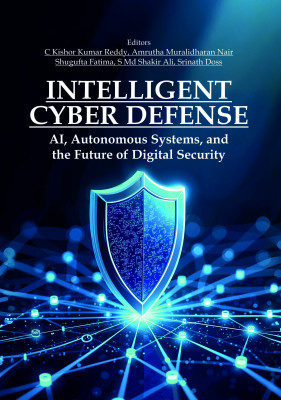
edited by: C Kishor Kumar Reddy, Amrutha Muralidharan Nair, Shugufta Fatima ,S Md Shakir Ali & Srinath DossLength: 152 mm | Breadth: 27.8 mm | Height: 229 mm | Imprint: NIPA | Weight: 1600 GMS
Intelligent Cyber Defense: AI, Autonomous Systems, and the Future of Digital Security presents a comprehensive and multidisciplinary exploration of how artificial intelligence is redefining modern cybersecurity. As cyber threats grow in scale, complexity, and autonomy, conventional rule-based and signature-driven security mechanisms are increasingly inadequate. This book advances a new paradigm—intelligence-driven, adaptive, and trustworthy cyber defense systems—capable of anticipating, learning from, and responding to evolving threats in real time.
The volume brings together cutting-edge research and applied perspectives across key domains, including AI-enabled threat detection, reinforcement learning-based defense systems, federated and privacy-preserving learning, explainable artificial intelligence, behavioral biometrics, intelligent honeypots, malware evolution analysis, and AI-powered Security Operations Centers. Emerging application areas such as cloud security, Internet of Things (IoT) protection, zero-trust architectures, synthetic data generation, and metaverse security are examined in depth, reflecting the expanding digital attack surface of contemporary cyber ecosystems.
Special emphasis is placed on trust, transparency, ethics, and governance, addressing critical challenges such as model explainability, data privacy, bias mitigation, regulatory compliance, and responsible AI deployment. Through theoretical foundations, real-world case studies, benchmark datasets, and future outlooks, the book bridges the gap between academic research and operational cybersecurity practice.
Designed for researchers, postgraduate students, cybersecurity professionals, system architects, and policymakers, this edited volume serves as both a reference and a roadmap for building resilient, intelligent, and ethically grounded cyber defense infrastructures. It is a timely contribution for those seeking to understand and shape the future of AI-enabled cybersecurity in an increasingly interconnected and automated digital world.
Dr. C. Kishor Kumar Reddy is currently working as an Associate Professor in the Department of Computer Science and Engineering at Stanley College of Engineering and Technology for Women, Hyderabad, India.He has over 12 years of teaching and research experience.He has published more than 210 research papers in national and international conferences, book chapters, and Scopus-indexed journals and other reputed publications.He is the author of 2 textbooks and has edited more than 25 books.He is a member of professional bodies such as ISTE, CSI, IAENG, UACEE, and IACSIT.His research interests include Bioinformatics, Neuroscience, Remote Sensing, Deep Learning, and Intelligent Systems.
Dr. Amrutha Muralidharan Nair is a dedicated Assistant Professor in the Department of Artificial Intelligence and Data Science at Adi Shankara Institute of Engineering and Technology, Kalady, with over 11 years of academic experience.She holds a Ph.D. in Computer Science and Engineering with a specialization in Cyber Security from Karpagam Academy of Higher Education, Coimbatore.Her core expertise includes Cyber Security, Artificial Intelligence, and Image Processing, along with additional work in Machine Learning and Generative AI.
She is a prolific researcher with numerous publications and patents. She is deeply committed to mentoring students in research and innovation, continuously contributing to the advancement of knowledge in her areas of specialization.
Mrs. Shugufta Fatima is an Assistant Professor in the Department of Computer Science and Engineering at Stanley College of Engineering and Technology for Women, Hyderabad, India, with 8 years of teaching experience.She holds Bachelor’s and Master’s degrees in Computer Science and Engineering from Osmania University, where she received multiple Academic Excellence awards.Her areas of interest include Machine Learning, Deep Learning, and Artificial Intelligence. She has published research papers in reputed journals and holds a patent in her field.She also serves as a book chapter reviewer with IGI Global and has organized workshops, conferences, and mentoring sessions to promote learning and innovation.
She is dedicated to creating an inclusive and engaging learning environment and inspires intellectual curiosity and critical thinking through innovative teaching methods.
Dr. S Md Shakir Ali is an accomplished academician, digital entrepreneur, and mentor with over 26 years of combined industry and academia experience.He is currently serving as a Mentor and Senior Lecturer at Lithan Academy (eduCLaaS), Singapore. He has also worked as an Associate Professor at an Osmania University–affiliated college and collaborates with several South-East Asian institutions.
He holds a Ph.D. in Management along with multiple professional certifications, combining academic expertise with practical digital business knowledge. He mentors startups and MSMEs across India, the United States, and the United Kingdom.He is a serial entrepreneur and prolific researcher with numerous publications in ABDC, Scopus, Springer, and other international platforms. He has contributed books and book chapters in digital marketing, neuromarketing, and international business, and also serves on editorial boards of reputed journals.
He is a frequent speaker at global forums and actively promotes curriculum innovation while empowering learners with industry-relevant skills for the evolving digital economy.
Dr. Srinath Doss was born in India in 1982 and currently resides in Botswana.He completed his B.Tech. from the University of Madras in 2004, followed by an M.Eng. degree from Anna University in 2006. He earned his Ph.D. from St. Peter’s University in 2014. He also holds a Post Graduate Diploma in Higher Education (PGDHE) from Botho University (2017), Certified Information Systems Auditor (CISA) from ISACA (2020), and a Post Graduate Certification in Cyber Security from the Indian Institute of Technology, Palakkad (2023).He is currently working as Professor and Dean, Faculty of Engineering and Technology, Botho University, Botswana. Previously, he served at various colleges in India and at Garyounis University, Libya.
He has authored 2 books and published around 80 research articles in refereed international journals and conferences. His research interests include MANET, information security, network security and cryptography, cloud computing, wireless and sensor networks, and mobile computing.
He serves as an editorial board member and reviewer for reputed international journals and is an advisory member and session chair for various international conferences. He is a member of IAENG and an Associate Member of UACEE.
Chapter 1.Foundations of AI-Powered Cybersecurity:Integrating Machine Learning with Traditional Defense Architectures
Chapter 2.The Role of Deep Learning in Identifying and Mitigating Advanced Persistent Threats (APTs)
Chapter 3.Reinforcement Learning Techniques for Enhancing Cyber
Chapter 4.Federated Learning in Cybersecurity: Enabling Privacy-Preserving Intrusion Detection System Across Distributed Environments
Chapter 5.A Comprehensive Framework for DDoS Intrusion Detection Using CICIDS 2017 Through Preprocessing, Modeling and Explainability with XGBoost and CICIDS 2017
Chapter 6.AI-Driven Behavioural Biometrics for Continuous User Authentication and Fraud Prevention
Chapter 7.AI-Augmented Threat Hunting- Leveraging Predictive Models for Cyber Defence
Chapter 8.Intelligent Honeypots: AI Techniques for Deception,Attack Attribution, and Intrusion Analysis
Chapter 9.Machine Learning for Malware Classification and Evolutionary Threat Analysis
Chapter 10.The Application of Reinforcement Learning in Dynamic Cyber Defense and Intrusion Prevention
Chapter 11.AI-Powered Security Operations Centers (SOCs):Redefining Cyber Defense through Automation and Intelligence
Chapter 12.Ethical Implications and Policy Considerations of Using Artificial Intelligence in Cybersecurity Domains.
Chapter 13.Zero Trust Architecture and AI: Building Self-Adaptive Security Ecosystems for Enterprise Environments
Chapter 14.Autonomous Cyber Defense Agents: Opportunities and Challenges in Building AI-Driven Self- Defending Systems
Chapter 15.Securing the Internet of Things (IoT) using Lightweight AI Models and Distributed Intelligence Mechanisms
Chapter 16.AI in Cloud Security: Threat Detection, Compliance Monitoring, and Intelligent Response Automation
Chapter 17.Synthetic Data Generation for Training AI Cybersecurity Models: Methods, Applications, and Limitations
Chapter 18.Cybersecurity in the Metaverse: Leveraging AI to Safeguard Extended Reality (XR) Environments and Digital Avatars
Chapter 19.Transparent and Distributed Cyber Defense: Integrating Explainable AI with Federated Learning