Keywords
Agricultural Meteorology, Agroclimatology, Weather–Crop Interaction,Climate Variability, Monsoon Dynamics, Evapotranspiration, Solar Radiation, Crop Microclimate,Agroecosystem, Drought Assessment, Weather Forecasting, Agrometeorological Advisory, Remote Sensing,Crop–Weather Modeling, Climate Change Impacts, Phenology, Soil–Plant–Atmosphere Continuum, Extreme Weather Events, Pest and Disease Prediction, Sustainable AgricultureAgricultural Meteorology: Principles and Practices
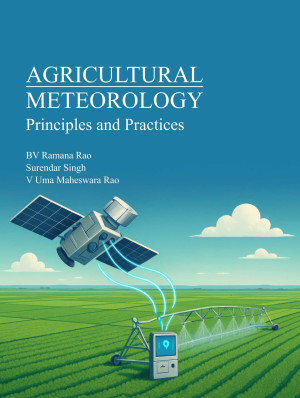
authored by: B V Ramana Rao, Surendar Singh & V Uma Maheswara RaoLength: 152 mm | Breadth: 14.5 mm | Height: 229 mm | Imprint: NIPA | Weight: 540 GMS
The dynamic interplay between the atmosphere and agricultural systems forms the foundation of sustainable food production. As climate variability intensifies and the need for global food security grows, the discipline of Agricultural Meteorology has become more vital than ever. It offers the scientific lens through which we understand how weather influences every crop, every field, and every strategic decision made in agriculture.
The book has been meticulously crafted as an essential resource for students, educators, and practitioners seeking a strong foundation in this discipline. The primary objective of this book is to present a comprehensive, clear, and logically structured exposition of the fundamental principles of agricultural meteorology, while vividly demonstrating their practical applications in crop production and management.
The book begins with foundational concepts in general meteorology and climatology and gradually transitions into the specialized domain of agricultural meteorology. It unravels the intricate relationships between weather parameters and every stage of crop growth—from germination to harvest—highlighting their influence on plant development, productivity, and resilience. Practical applications are emphasized throughout: the use of weather forecasts in farm planning, strategies for managing weather-induced risks such as droughts and floods, and the importance of agrometeorological insights in anticipating and mitigating pest and disease outbreaks.
Contemporary and emerging themes—including crop–weather modeling, remote sensing, and the impacts of climate change on agriculture—are addressed in depth to equip readers with a holistic and forward-looking understanding of the subject. Complex scientific concepts are presented in an accessible and student-friendly manner, supported by examples and quantitative illustrations that encourage applied learning and analytical thinking.
V Ramana Rao has been a towering figure in the field of Agricultural Meteorology, with a distinguished career spanning over four decades. He began his academic journey at the University of Agricultural Sciences, Bangalore, where he taught Agricultural Meteorology from 1966 to 1979. Subsequently, he joined the Indian Council of Agricultural Research and served in various key capacities until his superannuation in April 2000. He held the position of Head, Division of Climatology, Wind Power, and Solar Energy Utilization at ICAR- CAZRI, Jodhpur, and later became the Founder Project Coordinator of the pioneering AICRP on Agrometeorology, ICAR-CRIDA, Hyderabad, from December 1984 to March 1994.
Professor Rao’s contributions to the advancement of agrometeorology are both foundational and transformative. His research significantly shaped key areas such as agroclimatic characterization, delineation of efficient cropping zones, crop-weather modeling, classification and management of agricultural droughts, and operational agrometeorology. He has published over 150 research papers, including 50 papers in high-impact international journals, reflecting his global scientific standing. In addition, he has authored 20 books and monographs, along with numerous technical and scientific bulletins. He served with distinction as the Editor-in-Chief of the Journal of Agrometeorology for an impressive 14 years (2009–2023), elevating the journal’s stature and influence in the global agrometeorological community. He was awarded the prestigious British Council Fellowship (1986–87) for advanced training at the University of Reading, UK. In recognition of his lifelong contributions to the field, he was honored with the title of Honorary Fellow (2011) and conferred the Lifetime Achievement Award (2025) by the Association of Agrometeorologists.
Surender Singh brings with him over thirty-five years of distinguished experience in the field of agrometeorology, marked by excellence in teaching, research, outreach, and academic administration. He earned his PhD in Agrometeorology under the mentorship of Dr V Uma Maheswara Rao and has served in various esteemed capacities at Chaudhary Charan Singh Haryana Agricultural University, Hisar, India including Principal Scientist, Professor & Head, Senior Scientist, Assistant Scientist, Advisor (Recruitments), and Assoc Director (Students’ Counseling and Placement). A meritorious scholar, he is the recipient of two Gold Medals-one for Best Research Work during his doctoral program, and the other for the Best PhD Dissertation, awarded by the then President of India, Dr APJ Abdul Kalam. He was twice offered the prestigious UK Universities Vice Chancellors’ Scholarship under the Commonwealth Fellowship Program for higher studies. His international academic journey includes post-doctoral fellowships at the International Centre for Theoretical Physics, Trieste, Italy; Instituto Agronômico, Campinas, Brazil; and BOKU-Met – Institute of Meteorology and Climatology, Vienna, Austria.
Dr Singh is a life member of numerous professional societies, including the Association of Agrometeorologists, Indian Meteorological Society, Indian Society of Remote Sensing, International Society for Agrometeorology, Society for Sustainable Agriculture and Resource Management, ESPERE, European Drought Centre and SAFOAM. He has organized several national-level trainings, seminars, and symposia in Agrometeorology and allied fields. His academic contributions include over 250 publications, encompassing research papers, popular articles, manuals, teaching aids, and book chapters. In addition, he has authored 30 books and monographs, along with numerous technical and scientific bulletins. He has served as Managing Editor of the Journal of Agrometeorology, Vice President of Association of Agrometeorologists and contributed internationally as Research Collaborator with MARCO (Japan) and SPARC, ETH Zurich (Switzerland). His expertise has been recognized globally, with appointments to the Expert Team on Agrometeorology (CAgM-WMO, Geneva) from 2018 to 2020, and as a Core Committee Member on Agriculture-Drought at WMO, Geneva for two consecutive terms (2021–24 and 2024–27). He also serves as an External Expert for Research Project Evaluation at the COST Association, European Union, Brussels. A dedicated mentor, Dr. Singh has guided numerous undergraduate, postgraduate, and doctoral students who now serve in prominent positions across India. Widely traveled, he has represented India across the globe in academic and scientific forums. In recognition of his exemplary achievements and enduring impact on agrometeorological science, he was conferred the prestigious title of Fellow of the Association of Agrometeorologists (FAAM) in 2024.
V Uma Maheswara Rao is a seasoned expert in Agrometeorology, with over four decades of extensive experience in teaching, research, extension, and academic administration. He holds a PhD in the broad field of Agrometeorology and has served in various distinguished roles including Project Coordinator, Principal Scientist, Professor & Head, Agrometeorologist, and Assistant Scientist at CCS Haryana Agricultural University and under the Indian Council of Agricultural Research (ICAR). Throughout his career, Dr Rao has been instrumental in shaping the growth and direction of agrometeorological science in India. He has actively contributed to the development and dissemination of agrometeorological knowledge by organizing and leading numerous national and international training programs, workshops, and capacity-building initiatives, aimed at empowering students, researchers, and field professionals alike. He is a life member of several esteemed professional and scientific organizations, including the Indian Meteorological Society, The Arid Zone Research Association of India, Indian Society of Remote Sensing, Association of Agrometeorologists, International Society for Agrometeorology and The Indian Society of Dryland Agriculture. He has served as President of Association of Agrometeorologists.
With an exceptional academic footprint, he has authored and published more than 345 scholarly contributions, including research papers, popular articles, manuals, teaching aids, bulletins, and book chapters. In addition, he has authored 35 books and monographs, along with numerous technical and scientific bulletins. His leadership and expertise were globally acknowledged when he served as a member of the CCl-ET-IIC of the World Meteorological Organization, Geneva (2014–2017). He was also appointed to the XI Plan High Powered Review Committee of the MoES, Govt of India, in 2012. In recognition of his visionary leadership, the prestigious Chaudhary Devi Lal Award for the Best AICRP on Agrometeorology was conferred by ICAR in 2014, under his stewardship as Project Coordinator. A passionate mentor, he has guided a large number of undergraduate, postgraduate, and doctoral students, many of whom now hold key positions across the country in the domain of Agrometeorology. His professional engagements have taken him to numerous countries, representing India in various scientific forums and collaborative projects. His vast experience, dedication to education, and deep commitment to agrometeorological research continue to inspire the next generation of scientists and practitioners.
Chapter 1.Agricultural Meteorology in the Service of Agriculture
Chapter 2.Basics of Crop-Weather Relationships
Chapter 3.Biotic Interferences to Crop Growth
Chapter 4.Crop Weather Calendars - A Strategic Blueprint for Agriculture
Chapter 5.Evaporation, Evapotranspiration, and Crop Water Use
Chapter 6.Inter Relationship between Surface Energy Budget and Soil Water Balance
Chapter 7.Optimum Weather Conditions Required for Growing Different Crop
Chapter 8.Effect of Extreme Weather Conditions on Crops
Chapter 9.Agricultural Droughts
Chapter 10.Tools, Models, and Research Needs for Drought Management
Chapter 11.Effect of Weather and Climate on Humans and Animals