Keywords
Agrometeorology, Solar Radiation, Atmospheric Pressure, Wind Patterns, Humidity, Thermal Regime, Crop Phenology, Precipitation, Cloud Classification, Monsoon Mechanism, Weather Forecasting, Climate Change, Natural Farming, Microclimate Modification, Weather Hazards, Evapotranspiration, Climate Normals, Condensation Processes, Agrometeorological Advisory Services, Drought and Flood ManagementWeather Forecasting
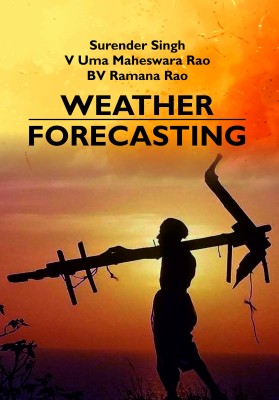
authored by: Surender Singh, V Uma Maheswara Rao, BV Ramana RaoLength: 152 mm | Breadth: 22.3 mm | Height: 229 mm | Imprint: NIPA | Weight: 760 GMS
Natural farming, rooted in ecological balance and minimal external inputs, deeply depends on understanding natural rhythms - especially weather patterns. This book, Weather Forecasting is designed as a foundational resource to equip learners, young farmers, and practitioners with essential knowledge of weather science and its practical applications in natural farming.
The book provides a simplified yet scientifically grounded introduction to weather systems, forecasting techniques, and agrometeorological tools. It emphasizes how farmers practicing natural or organic farming can benefit from timely weather forecasts to plan critical activities such as sowing, irrigation, mulching, plant protection, and harvesting. With changing climate conditions and increasing weather uncertainties, the book underscores the need for every natural farmer to become ‘weather literate’ - able to read forecasts, interpret signals from nature, and respond appropriately.
Chapters cover topics such as cloud types and rainfall prediction, wind and temperature patterns, monsoon behavior, local weather indicators, and traditional weather wisdom, along with an introduction to modern agrometeorological tools, techniques and farm-advisories. Written in a student-friendly style with illustrations, summary tables, and practical tips, this book bridges the gap between atmospheric science and ground-level sustainable farming. It is especially relevant for students of agricultural universities, natural farming training programs, rural institutions, and extension workers.
By integrating weather intelligence into natural farming, this book hopes to empower the next generation of climate-smart, ecologically mindful farmers who can work in harmony with nature — sustainably and profitably.
Surender Singh has about thirty five years of experience with PhD in the field of Agrometeorology. Worked in Agrometeorology encompassing teaching, research, extension and administration at various capacities viz., Principal Scientist, Professor & Head, Senior Scientist, Assistant Scientist, Advisor (Recruitments) and Associate Director (Students’ Counseling and Placement) at CCS Haryana Agricultural University, Hisar, India. Recipient of Two Gold Medals for Best Research Work during PhD Program and for Best PhD Dissertation (2001-02) awarded by then President of India Dr APJ Abdul Kalam. Offered UK Universities Vice Chancellors’ Scholarship for Higher Studies twice (1991 & 1993) under Commonwealth Fellowship Program. Post Doctoral Fellow at Abdus Salam International Centre for Theoretical Physics, Trieste, Italy; IAC – Instituto Agronômico, Campinas, Brazil and BOKU (Met) - Institute of Meteorology and Climatology, Vienna, Austria.
He is life member of Association of Agrometeorologists, Indian Meteorological Society, Indian Society of Remote Sensing, International Society for Agrometeorology, Society for Sustainable Agric& Resource Management, Environment Science Published for Everybody Round the Earth (ESPERE), European Drought Centre, South Asian Forum on Agriculture Meteorology (SAFOAM) and The Geographical Society of India. Organized quite a few trainings/symposia in Agrometeorology and associated domains at National level. Published more than 250 research papers, popular articles, manuals/teaching aids and research bulletins/book chapters etc. Performed responsibilities as Managing Editor - Journal of Agrometeorology; Research Collaborator, Monsoon Asia Agro-Environmental Research Consortium (MARCO), Japan; SPARC Research Collaborator, ETH, Zurich, Switzerland; Member, Expert Team - CAgM-WMO, Geneva, Switzerland (2018-20). Core Committee Member on Agriculture – Drought at WMO, Geneva, Switzerland (2021-24 & 2024-27). External Expert for evaluation of research projects, COST-Association, European Union, Brussels, Belgium. Many students (UG, PG and PhD) have been trained under him and placed across the country and well settled in various positions in the field of Agrometeorology. He is widely travelled researcher/expert across the globe on many academic pursuits. He has been conferred upon Fellow of Association of Agrometeorologists (FAAM) for the year 2024 in recognition of his exemplary achievements and enduring impact on agrometeorological science
V Uma Maheswara Rao has forty years of experience with PhD in the broader field of Agrometeorology. Worked in Agrometeorology encompassing teaching, research, extension and administration at various capacities viz., Project Coordinator, Principal Scientist, Professor & Head, Agrometeorologist, and Assistant Scientist at CCS Haryana Agricultural University and Indian Council of Agriculture Research in India.
He is life member of Indian Meteorological Society, The Arid Zone Research Association of India, Indian Society of Remote Sensing, Association of Agrometeorologists, International Society for Agrometeorology, and The Indian Society of Dryland Agriculture. Organized several trainings/workshops in Agrometeorology at the International and National level. Published more than 345 research papers, popular articles, manuals/teaching aids and research bulletins/book chapters. Member of the CCI-ET-IIC, WMO, Geneva (2014-2017). Member of XI Plan High Powered Review Committee of Ministry of Earth Sciences, Government of India (2012). In 2014, the prestigious Chaudhary Devi Lal Award, ICAR’s Best AICRP on Agrometeorology was received under his dynamic leadership as Project Coordinator. Many students (UG, PG and PhD) have been trained under his guidance are placed across the country and settled in various positions in the field of Agrometeorology. He visited numerous countries in official capacity.
BV Ramana Rao taught Agricultural Meteorology in the University of Agricultural Sciences, Bangalore during the years 1966 to 1979 and later joined the Indian Council of Agricultural Research and superannuated from service during April, 2000. He served as Head, Division of Climatology, Wind Power and Solar Energy Utilization at ICAR-Central Arid Zone Research Institute, Jodhpur (Rajasthan); founder Project Coordinator, All India Coordinated Research Project on Agrometeorology at ICAR Central Research Institute for Dryland Agriculture, Hyderabad (Telangana) during December 1984 to March 1994. His major contributions in the field of Agrometeorology include Agroclimatic Characterization, Delineation of Efficient Cropping Zones, Crop Weather Modeling, Classification and Management of Agricultural Droughts, Operational Agrometeorology, etc. He published about 150 research papers in peer reviewed journals with 50 of his papers appearing in high impact International Journals. He authored 15 books and monographs and a number of scientific and technical bulletins. He served as Editor in Chief, Journal of Agrometeorology during the years 2009 to 2023.
He is the recipient of British Council Fellowship during the year 1986-87 for advanced training at University of Reading, United Kingdom. He was conferred as Honorary Fellow (2011) and Life Time Achievement Award (2025) by the Association of Agrometeorologists for his valuable contribution to the growth and development of Agricultural Meteorology in India.
1. Introduction to Agricultural Meteorology
2. Ancient Wisdom of Weather Forecasting
3. Earth‘s Atmosphere, Weather and Climate
4. Atmospheric Pressure and Wind
5. Solar Radiation
6. Atmospheric Temperature
7. Thermal Regime, Crop Growth & Development
8. Water Vapor in the Atmosphere
9. Processes of Condensation
10. Cloud Formation and Classification
11. Precipitation & its Forms
12. Monsoons & their Mechanism
13. Weather Hazards
14. Microclimatic Modifications
15. Climate Normals for Crops and Livestock
16. Weather Forecasting for Farming
17. Climate Change and Agriculture
18. Weather and Agriculture Relationship
19. Agricultural Meteorology: An Essential Associate for Natural Farming