Keywords
Food Chemistry, Laboratory Manual, Food Analysis, Food Technology, Food & Nutrition, Practical Food Chemistry, Food Quality Eva,uation, AOAC Methods, FSSAI Standards,Codex Guidelines, pH Determination, Titration Techniques, Lipid Analysis, Protein Chemistry, Sugar Crystallization Flour and Dough Analysis, Food Laboratory Experiments,Quality Control in Foods,Undergraduate Practical Guide, Applied Food ScienceFood Chemistry: Practical Applications and Quality Analysis
authored by: Pragya Pandy, Pintu Choudhary and Anisha VermaLength: 152 mm | Breadth: 5.6 mm | Height: 229 mm | Imprint: Content Vibes | Weight: 250 GMS
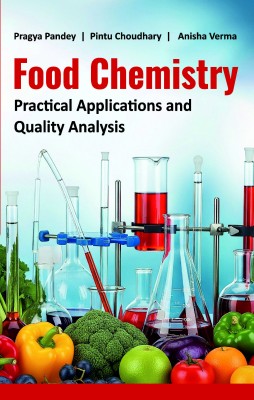
The book is a comprehensive, application-oriented laboratory guide designed primarily for undergraduate students of Food & Nutrition, Food Technology, and allied disciplines. The manual provides a systematic foundation in food chemistry through well-structured experiments that link theoretical concepts with hands-on laboratory practice. It covers fundamental measurements, preparation and standardization of solutions, pH determination and titration techniques, osmotic and thermal effects in foods, analysis of flour and dough properties, sugar chemistry and crystallization, lipid and fat quality evaluation, and the effect of heat on proteins.
Each experiment is presented with clear objectives, underlying theory, step-by-step procedures, observation tables, calculations, results, and reflective questions, enabling students to develop analytical accuracy and scientific reasoning. The inclusion of student worksheets and reference standards (AOAC, FSSAI, Codex) makes the manual suitable for routine practical classes, skill-based learning, and quality control training. Overall, the book serves as a practical bridge between classroom learning and real-world food analysis, supporting competency development aligned with academic and industry requirements
The book is a comprehensive, application-oriented laboratory guide designed primarily for undergraduate students of Food & Nutrition, Food Technology, and allied disciplines. The manual provides a systematic foundation in food chemistry through well-structured experiments that link theoretical concepts with hands-on laboratory practice. It covers fundamental measurements, preparation and standardization of solutions, pH determination and titration techniques, osmotic and thermal effects in foods, analysis of flour and dough properties, sugar chemistry and crystallization, lipid and fat quality evaluation, and the effect of heat on proteins.
Each experiment is presented with clear objectives, underlying theory, step-by-step procedures, observation tables, calculations, results, and reflective questions, enabling students to develop analytical accuracy and scientific reasoning. The inclusion of student worksheets and reference standards (AOAC, FSSAI, Codex) makes the manual suitable for routine practical classes, skill-based learning, and quality control training. Overall, the book serves as a practical bridge between classroom learning and real-world food analysis, supporting competency development aligned with academic and industry requirements
Pragya Pandey, Assistant Professor, Department of Food and Nutrition, College of Community Science, Acharya Narendra Deva University of Agriculture and Technology, Kumarganj, Ayodhya - 224229, Uttar Pradesh, India
Pintu Choudhary, Assistant Professor, Department of Food Technology College of Agricultural Engineering and Technology, Dr. Rajendra Prasad Central Agricultural University, PUSA, Samastipur - 848 125, Bihar, India
Anisha Verma, Associate Professor, Department of Food and Nutrition, College of Community Science, Acharya Narendra Deva University of Agriculture and Technology, Kumarganj, Ayodhya - 224229, Uttar Pradesh, India
Chapter 1. Fundamental Measurements in Food Chemistry
Chapter 2. Preparation and Standardization of Solutions
Chapter 3. pH Measurement and Titrations
Chapter 4. Osmotic and Thermal Effects in Foods
Chapter 5. Analysis of Flour and Dough Properties
Chapter 6. Sugar Chemistry and Crystallization
Chapter 7. Analysis of Lipids and Fats
Chapter 8. Effect of Heat on Proteins