Keywords
Secondary dormancy, Soil seed bank, Indicator plants, Stale seed bed, Weed shift, Crop weed competition, Critical period of weed competition, Season bound weeds, Indicator plants, Herbicide resistance, Integrated weed control, Invasive alien species, Allelopathy, Weedy rice, Biological control, Bio herbicides, Herbicide selectivity, Aquatic weeds, Parasitic weeds, Adjuvants, Roundup-ready Corn, Strigaway, Pusa basmati, Fate of herbicides, Herbicide formulations, Tank mix, Dosage estimation, Herbicide tolerant crops, Herbicide –insecticide interaction, Herbicide–fertilizer interaction, Translocation of herbicides, Weed index, Weed control efficiency, Loranthus control, Broomrape control, Witchweed control, Doddar control, weed control in tea, coffee, rubber, cotton, oilseeds, cereals, pulses, orchards, Herbicide tolerant GM crops, Transgenic allelopathyScientific Weed Management
authored by: T. Girija, K.M. Durgadevi & C.T. AbrahamLength: 152 mm | Breadth: 17 mm | Height: 229 mm | Imprint: NIPA | Weight: 550 GMS
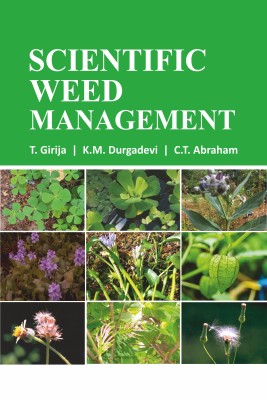
Weeds are an integral part of any ecosystem, they are plant flora which dominates the ecosystem. Harnessing their dominance has been a challenge to man since he started cultivation. Understating weeds and improvising our techniques has always been the strategy to control them. The book “Scientific Weed Management” contains 17 chapters which explains the biology, physiology and competitiveness of weeds, different strategies including agronomic, chemical and biological approaches used in their management and control and also how to integrate these techniques to get better results. Use of chemicals in weed control, mode of action and fate of the chemicals in the environment, compatibility of herbicides with other agrochemicals and also the different adjuvants used in formulations is indicated in the book. Dosage estimation and methods of application is also dwelt with in detail. The book also deals with aquatic and parasitic weeds and their control. Information on the commonly used techniques and chemicals used for weed control in field crops and horticultural crops is given. It gives an insight on the modern techniques advocated for weed control which will reduce the chemical load on the environment
Dr. (Mrs.) T. Girija was born in Palakkad district of Kerala. She did her B. Sc. (Agriculture) at Kerala Agricultural University (KAU), Vellanikkara, Thrissur and her M.Sc. and Ph.D. in Crop Physiology at Tamil Nadu Agricultural University (TNAU), Coimbatore. She started her career in the National Seeds Project at Regional Agricultural Research station Pattambi and then worked for 20 years in All India Co-ordinated Research Project on Weed Control of Kerala as weed physiologist. She was also Principal Investigator and Head of the project for 2 years. She is a recipient of the young scientist award of the State Council for Science, Technology and Environment and also an award for best paper presentation in Biotechnology. She has specialised in the control of parasitic weed, Loranthus and published about 50 papers in peer reviewed journals. She has guided 2 Ph. D students and 9 M. Sc. students in Plant Physiology and retired as the Professor and Head of the Department of Plant Physiology, College of Agriculture, Kerala Agricultural University, Thrissur.
Dr.(Mrs.) K.M. Durga Devi was born in Thrissur district, Kerala. She acquired her B.Sc. (Ag.), M.Sc. (Soil Science & Agrl. Chemistry) and Ph.D. (SS&AC) from Kerala Agricultural University, Thrissur. She began her career as Agricultural Officer, State Department of Agriculture, Kerala and then joined Kerala Agricultural University at Operational Research Project, Ozhalapathy and later joined the All India Project on Weed Control of Kerala as residue chemist and carried out research on herbicide residues in soil, plant and aquatic systems for 25years. She handled two ad-hoc projects on “Persistence of herbicides in water bodies and its impact on aquatic system” and on “Persistence of glyphosate and POEA (surfactant) in soil and water-bioaccumulation of residues in fish” and also established a herbicide residue laboratory in the college. She has guided 2 Ph.D. students and 8 M.Sc. students in Soil Science, authored more than 50 publications and retired as the Professor and Head of the Department of Soil Science and Agricultural Chemistry, College of Agriculture, Kerala Agricultural University, Thrissur.
Dr. C. T. Abraham was born in Kottayam District of Kerala. Did his B.Sc. (Agriculture) and M.Sc in Agronomy at Kerala Agricultural University (KAU) and took his Ph.D. from Indian Agricultural Research Institute (IARI), New, Delhi. He conducted post-doctoral research at Jawaharlal Nehru University (JNU) and also at Auburn University, USA. He joined Kerala Agricultural University and was the Principal Investigator and head of the All India Project on Weed Control of Kerala for 25 years. He specialised in weed science and concentrated on weed management in plantation crops, rice and aquatic weeds. He received Fellow and Gold Medal awards from Indian Society of Weed Science (ISWS) and Crop and Weed Science Society (CWSS). He has guided 5 Ph.D. and 6 M.Sc. students on topics in weed management. He has authored and published more than 60 papers in refereed journals. He retired as the Dean of College of Agriculture, Kerala Agricultural University Thrissur.
1.Introduction to weed science and management, 2.Weed classification, 3.Ecology and biology of weeds, 4.Weed control practices, 5. Biological Control, 6. Herbicides in weed management, 7.Classification of herbicides, 8.Absorption, translocation and selectivity of herbicides, 9.Adjuvants and safners, 10. Formulations, dosage and application, 11. Compatibility and interaction of herbicides with other agro-chemicals, 12. Fate of herbicide in soil, 13. Weeds of aquatic systems and their management,14. Parasitic weeds and their management,15. Weed management in field crops, 16. Weed management in horticultural crops, 17. Modern approaches in weed science and management, Annexures