Keywords
Drawbar power & tractive efficiency, PTO power & transmission (clutch–gearbox–differential), BSFC (brake-specific fuel consumption) & thermal efficiency, Compression ratio; SI vs CI; 2-stroke vs 4-stroke cycles, Cooling & lubrication systems (water/air; splash/pressure),Draft & unit draft (kN/m) for tillage, Field capacity (theoretical/effective) & field efficiency, Wheel slip & ballasting/tyre inflation Mouldboard plough—share, mouldboard, landside (functions),Disc plough/offset disc harrow vs rotavator (L-/C-blades), Secondary tillage: cultivator, harrow, leveller, ridger, post-hole digger,Metering mechanisms—fluted roller, plate/cell, pneumatic (vacuum), Seed-cum-fertilizer drill; potato planter (cup/belt), Transplanter mechanisms (finger/pick-and-place) & nursery trays Intercultural tools—sweep, rotary weeder, hoe, Sprayer nozzle types (flat-fan, hollow-cone) & VMD (droplet size), Sprayer calibration: Rate (L/ha) = 600 × q ÷ (spacing × speed), Aeroblast & electrostatic sprayers (principles, use-cases),Harvest tools—potato digger, fruit-plucker, seed extractor, lawn mower, Safety & ergonomics—PPE, guards, ROPS, safe operating proceduresFarm Power and Machinery for Horticulture
authored by: Sanjeev Kumar GargLength: 152 mm | Breadth: 20.3 mm | Height: 229 mm | Imprint: CONTENT VIBES | Weight: 300 GMS
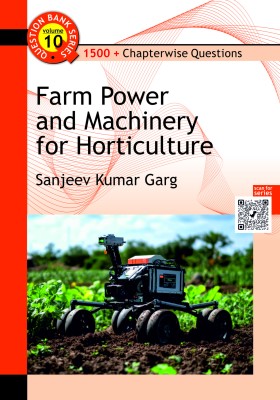
This book transforms the ICAR-aligned 8-unit syllabus of Farm Power and Machinery into a concise, high-yield, and examination-focused resource. Designed for undergraduate students, competitive examinations, and university assessments, it simplifies fundamental concepts through clear explanations, comparison tables, flowcharts, solved numericals, and objective practice questions.
Beginning with forms of energy and the role of tractors and power tillers in modern agriculture, the book systematically covers internal combustion engines, including SI and CI engines, two-stroke and four-stroke cycles, fuel systems, cooling and lubrication mechanisms, transmission systems, and power take-off operations. Important numericals on power, torque, brake specific fuel consumption, and efficiencies are presented with step-by-step solutions and shortcuts.
The tillage section explains objectives, draft requirements, and the selection and adjustment of primary and secondary tillage implements such as mouldboard ploughs, disc ploughs, rotary tillers, cultivators, harrows, levellers, ridgers, and post-hole diggers. Planting and transplanting chapters compare seed metering mechanisms, potato and small-seed planters, nursery sowing devices, vegetable transplanters, and plastic mulch with drip-laying technologies.
Special emphasis is given to intercultural operations and plant protection equipment, including manual and tractor-mounted sprayers, boom and gun sprayers, aeroblast and electrostatic sprayers, calibration procedures, nozzle selection, droplet spectrum, and troubleshooting techniques. A dedicated unit on safety covers personal protective equipment (PPE), machine guards, rollover protective structures (ROPS), ergonomics, and safe operation of orchard machinery. The harvesting section includes potato diggers, fruit-pluckers, seed extraction devices, and lawn mowers.
Scoring Aids Included
• One-page revision charts and power-flow diagrams
• Tillage selection matrices and nozzle–crop matching tables
• Solved numericals on drawbar power, unit draft, field capacity, field efficiency, slip, and application rate
• Calibration and pre-operation checklists with safety lockout procedures
• Unit-wise MCQs (single-best answer and numerical), Assertion–Reason, Match-the-Pairs, and Short Answer Questions with answer keys and explanations
Built exactly on the prescribed syllabus, this book serves as a quick-revision companion and an effective tool for scoring success in university examinations, ICAR, State Agricultural University examinations, and various agricultural engineering competitive tests.
Sanjeev Kumar Garg is an accomplished Agricultural and Food Engineer with over 19 years of academic, research, and extension experience. He currently serves as an Professor in the Department of Post Harvest Management and Food Processing Technology at the College of Agriculture Engineering under Jawaharlal Nehru Krishi Vishwa Vidyalaya (JNKVV), Jabalpur.
Dr. Garg holds a Ph.D. in Post Harvest Process and Food Engineering from JNKVV, Jabalpur, and an M.Tech. in Process and Food Engineering from Govind Ballabh Pant University of Agriculture and Technology, Pantnagar, Uttarakhand. He also qualified the ICAR-NET in Agricultural Structures and Process Engineering in 2001.
Throughout his career, Dr. Garg has contributed significantly to teaching, guiding numerous undergraduate and postgraduate and Ph.D students, and actively engaging in research and farmer training programs. His areas of expertise include pulse milling, food grinding, extrusion processing, drying and dehydration technologies, and soy-based product development.
He has published more than 40 research papers in reputed national and international journals and has contributed to conference proceedings, popular articles, extension leaflets, and media programs such as radio talks and TV appearances. He has also represented India at the Biennial Conference of the Australian Society for Engineering in Agriculture in Adelaide (2007), presenting his work on extrusion processing.
Dr. Garg is a life member of several prestigious professional bodies including the Indian Society of Agricultural Engineering (ISAE) and the Association of Food Scientists and Technologists (AFSTI).
He has actively contributed to curriculum development, including the launch and restructuring of B.Tech. and M.Tech. programs in Food Engineering. Dr. Garg has also undergone various national-level training programs on scientific computing, sensory evaluation, multimedia, and pedagogy, enhancing his teaching and research acumen.
His continued commitment to the advancement of food engineering, combined with his dedication to education and rural development, underscores his stature as a leading expert in the field of Post Harvest Technology and Food Processing in India.
1 Basic Concepts of Various Forms of Energy; Tractors, Power Tillers and Their Types and Uses
2 Introduction About IC Engines: Basic Principles of Operation of Compression, Ignition and Spark Ignition Engines; Two Stroke and Four Stroke Engines; Crank System, Valve System, Fuel Supply System, Cooling and Lubrication Systems; Power Transmission Systems; Broad Understanding of Performance and Efficiency
3 Tillage: Objectives, Method of Ploughing. Primary Tillage Implements: Construction and Function of Improved Indigenous Ploughs, Mould Board Ploughs, Disc and Rotary Ploughs, Offset Rotavators
4 Secondary Tillage Implements Construction and Function of Cultivators, Harrows, Levellers, Ridgers And Bund Formers. Adjustments Affecting Performance in Tillage Equipment. Post-Hole Digger
5 Introduction About Planting and Transplanting Equipment: Potato Planters, Small Seed Planter, Nursery Sowing Machinery, Vegetable Transplanters, Plastic Mulch and Drip Laying Machinery
6 Introduction About Intercultural Machinery. Sprayers: Types, Working Principle, Manual and Tractor Operated, Gun-Type and Boom Type. Special Purpose Sprayers: Aeroblast Sprayers, Electrostatic Sprayers, Sprayer Calibration and Nozzle Spacing
7 Safety Features and Safe Use, Shrub Cutters, Pick Positioner; Grafting, Pruning and Training Tools and Equipment; Sweep, Rotary Weeders, Tractor Operated Pruners
8 Crop Harvesting Equipment: Potato Diggers, Fruit-Pluckers, Seed Extraction Machine. Lawn Mower